


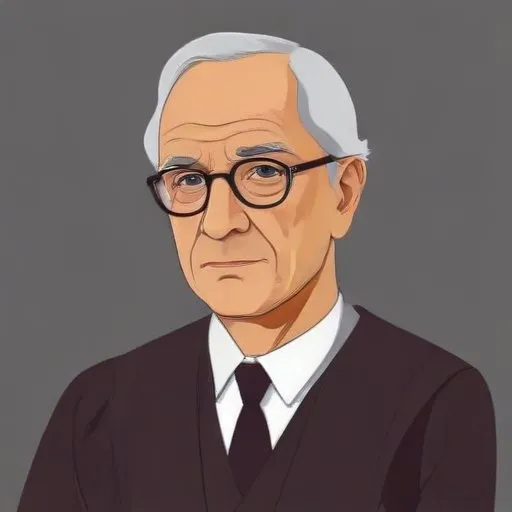
A courageous prosecutor who played a crucial role in bringing Nazi war criminals to justice, including Adolf Eichmann, and is considered a hero in the fight against impunity.
Fritz Bauer is best known for his instrumental role in the post-war capture of Adolf Eichmann, a former SS-Obersturmbannführer and one of the main planners of the Holocaust. As a German Jewish judge and prosecutor, Bauer's actions led to Eichmann's trial and conviction, bringing a sense of justice to the victims of the Holocaust and their families.
Fritz Bauer was born on July 16, 1903, in Stuttgart, Germany, to a Jewish family. His father, Ludwig Bauer, was a successful businessman who ran a textile mill, providing the family with a comfortable income. Bauer's mother, Ella Hirsch, raised him and his sister, Margot, in a liberal Jewish household, where they celebrated Jewish holidays and maintained a strong connection to their Jewish heritage.
Bauer attended Eberhard-Ludwigs-Gymnasium in Stuttgart and later studied business and law at the Universities of Heidelberg, Munich, and Tübingen. During his university days, Bauer joined the liberal Jewish fraternity, Freie Wissenschaftliche Vereinigung (Free Academic Union), which allowed him to find a sense of community and belonging in an academic environment that was largely dominated by the anti-Semitic volkisch movement.
In 1928, Bauer received his PhD in law and became an assessor judge in the Stuttgart local district court. He was just 25 years old at the time. Bauer's early career was marked by his involvement in the Social Democratic Party (SPD), which he joined in 1920. Stuttgart, where Bauer lived and worked, was a city with a strong left-wing working-class majority and a reputation for being a progressive city that flourished during the Weimar Republic.
After World War II, Bauer continued to work as a judge and prosecutor, determined to bring Nazi war criminals to justice. In 1957, Bauer received a tip about Eichmann's whereabouts in Argentina. He shared the information with Israeli authorities, leading to Eichmann's capture in 1960 and subsequent trial in Jerusalem.
Bauer's actions were instrumental in bringing Eichmann to justice, and his work paved the way for the Frankfurt Auschwitz trials, which took place from 1963 to 1965. The trials prosecuted former SS personnel who had been involved in the Auschwitz concentration camp, and Bauer played a key role in preparing the cases against them.
Fritz Bauer's legacy is one of courage and determination in the pursuit of justice. His work helped to bring Nazi war criminals to account for their atrocities, providing a sense of closure and justice for the victims of the Holocaust and their families.
Bauer's actions also underscored the importance of holding individuals accountable for their actions, even in the face of great evil. His legacy continues to inspire people around the world to stand up against injustice and fight for human rights.
Fritz Bauer never married and dedicated his life to his work. He died on July 1, 1968, at the age of 64, leaving behind a legacy that continues to inspire and educate people about the importance of justice and human rights.
Bauer's pursuit of justice for Nazi war criminals was not without controversy. He faced opposition from some who felt that it was time to move on from the past and focus on rebuilding Germany. However, Bauer remained committed to his work, driven by a strong sense of justice and a desire to bring accountability to those responsible for the atrocities of the Holocaust.
Today, Bauer is recognized as a hero and a champion of justice, and his work continues to inspire people around the world to stand up against injustice and fight for human rights.
"Justice is not revenge, but it is a prerequisite for freedom and humanity."
"The individual is responsible for his actions, and it is the duty of the state to hold him accountable."
Fritz Bauer's life and work took place against the backdrop of one of the most tumultuous periods in human history. His actions helped to bring a sense of justice and closure to the victims of the Holocaust, and his legacy continues to inspire people around the world to stand up against injustice and fight for human rights.
Bauer's work also highlights the importance of holding individuals accountable for their actions, even in the face of great evil. His legacy serves as a reminder of the importance of justice, accountability, and human rights, and continues to educate and inspire people around the world.
Born in 1876
Led post-war West Germany's reconstruction and served as a key figure in shaping the country's modern identity, earning him the title "Father of the Federal Republic."
Born in 1884
First President of post-war Germany, credited with rebuilding the country and promoting democracy. He's also known for his strong advocacy for human rights and freedom of the press.
Born in 1876
A German naval leader who played a key role in the Kriegsmarine during World War II, overseeing the German U-boat fleet and naval operations. He was a close advisor to Adolf Hitler and implemented the German naval strategy during the war.
Born in 1891
A German naval commander who led the U-boat fleet during World War II and briefly served as President of Germany after Hitler's death, known for his role in the war and its aftermath.
Born in 1918
A German leader who served as Chancellor from 1974 to 1982, known for his pragmatic and socially liberal policies, and his key role in shaping the European Union. He was also a respected economist and published author.
