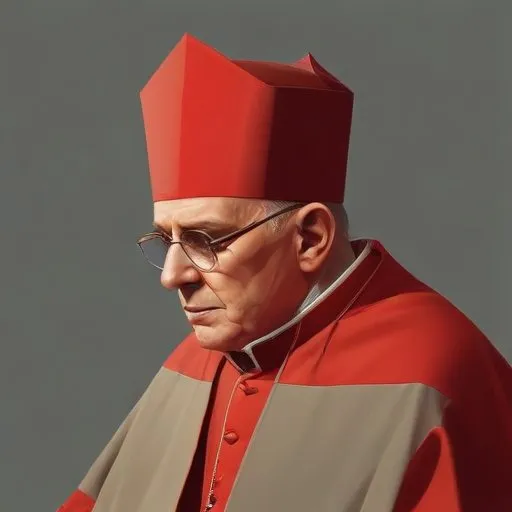
Gabriele Paleotti

Gabriele Paleotti

Gabriele Paleotti was born on October 4th, 1522

Full Name: Gabriele Paleotti
Nationality: Italian
Profession: Catholic cardinal
Born: 1522
Died: 1597
Church: Roman Catholic Church
Cardinal: 1570
Archbishop: Bologna

A 16th-century Catholic cardinal who played a key role in the Council of Trent, shaping the Catholic Church's response to the Protestant Reformation. He's also known for his writings on art and morality.

Written by: Isabel Sanchez Isabel Sanchez

Gabriele Paleotti: The Architect of Counter-Reformation Art

A Champion of Catholic Reforms

Gabriele Paleotti is remembered as a prominent figure in the later sessions of the Council of Trent, a significant event that shaped the Catholic Church's response to the Protestant Reformation. His magnum opus, De sacris et profanis imaginibus (1582), outlined the Counter-Reformation church's views on art, cementing his legacy as a champion of Catholic reforms.

Early Life and Education

Born on October 4, 1522, in Bologna, Italy, Paleotti was awarded the title of Doctor of Civil and Canon Law (utriusque iuris) in 1546. He began teaching civil law, but his calling lay elsewhere. In 1549, he became a canon of the cathedral, and although he didn't become a priest until later, his path was set.

A Rise to Prominence

Paleotti's career took off in 1555 when he gave up teaching to focus on his ecclesiastical pursuits. He became an Auditor or judge of the Roman Rota, the supreme Catholic ecclesiastical court, and eventually moved to Rome. Pope Pius IV recognized his talent and sent him to the Council of Trent, where he played a crucial role as a mediator between reformers and conservatives.

The Council of Trent and Beyond

Paleotti's Diarium, a detailed journal of the Council's proceedings, remains one of the most important documents for its history. After the Council, he became a member of the commission of cardinals and prelates that served as the basis of the Congregation of the Council. In 1565, he was elevated to the position of cardinal, and in 1567, he became the Bishop of Bologna.

A Legacy in Art and Reform

In 1582, Paleotti became the first Archbishop of Bologna, and his diocese was made an archdiocese. His introduction of the Tridentine reforms in his diocese was instrumental in shaping the Church's artistic expression. His treatise, De sacris et profanis imaginibus, outlined the Counter-Reformation church's views on art, emphasizing the importance of religious imagery and condemning profane art.

Personal Struggles and Triumphs

Despite his many accomplishments, Paleotti faced numerous challenges, including frustrations with an inadequate staff and indifferent clergy, as well as difficulties with the Papal governors of Bologna. However, his dedication to the Catholic Church and its reforms earned him recognition as a champion of Catholic renewal.

Legacy and Impact

Gabriele Paleotti's contributions to the Council of Trent, his role in shaping the Counter-Reformation, and his influence on Catholic art continue to inspire and inform. His legacy serves as a testament to the power of faith and reform, and his impact on Catholicism remains felt to this day.

Gabriele Paleotti's remarkable life and legacy continue to inspire and educate, serving as a testament to the power of faith and reform.

Timeline
1522
Born in Italy
Gabriele Paleotti was born on October 4, 1522, in Bologna, Italy.
1556
Became Bishop of Bologna
Gabriele became the Bishop of Bologna, a diocese in the Catholic Church.
1562
Participated in Council of Trent
Gabriele participated in the Council of Trent, a major ecumenical council of the Catholic Church.
1597
Died in Bologna
Gabriele died on July 5, 1597, in Bologna, Italy.
1598
Buried in Bologna Cathedral
Gabriele was buried in Bologna Cathedral, the principal church of the Archdiocese of Bologna.
Gabriele Paleotti

Gabriele Paleotti Quiz

What was Gabriele Paleotti's role in the Council of Trent?

Score: 0/5
FAQ
What was the role of Gabriele Paleotti in the Catholic Church?
Gabriele Paleotti was a Catholic cardinal and archbishop who played a significant role in the Catholic Church, serving as the Archbishop of Bologna and participating in several key councils and synods.
How did Gabriele Paleotti acquire his title?
Gabriele acquired his title as cardinal through his appointment by Pope Gregory XIII in 1571.
What were the key achievements of Gabriele Paleotti?
During his lifetime, Gabriele Paleotti was instrumental in promoting Catholic reform and addressing the challenges posed by the Protestant Reformation.
How did Gabriele Paleotti contribute to the development of Catholicism?
Gabriele Paleottis work helped to strengthen the Catholic Church and promote reform, laying the groundwork for future generations of Catholic leaders.
What is Gabriele Paleotti remembered for?
Gabriele Paleotti is remembered for his role in promoting Catholic reform and addressing the challenges of the Protestant Reformation. He is often regarded as an important figure in Catholic history.

Related People:

Pope Gregory XIII

Born in 1502

Introduced the Gregorian calendar, a solar-based calendar that's widely used today, reforming the Julian calendar's inaccuracies.

Pope Sixtus IV

Born in 1414

Established the Vatican Archives and commissioned the Sistine Chapel's ceiling, which was famously painted by Michelangelo. He also played a significant role in the Renaissance.

Pope Urban VIII

Born in 1568

The 17th-century Catholic leader who reigned for 21 years, known for his strong stance against Galileo Galilei and his scientific discoveries, as well as his extensive patronage of the arts.

Pope Innocent IX

Born in 1519

The 151st Pope of the Catholic Church, serving for only two months in 1591, he is mostly remembered for his brief and uneventful papacy.

Pope Clement VIII

Born in 1536

Led the Catholic Church during a tumultuous period, issuing papal bulls and playing a key role in the Counter-Reformation. He's also famous for his coffee habit, being the first Pope to try and approve of it.

Pope Leo XI

Born in 1535

The second shortest-reigning pope in history, serving for just 27 days in 1605, he is most known for his brief but tumultuous papacy marked by power struggles and controversy.

Pope Paul IV

Born in 1476

A fierce defender of Catholic orthodoxy, he implemented strict reforms and established the Roman Inquisition to root out heresy. His papacy was marked by controversy and conflict.

Pope Urban VIII

Born in 1568

The 17th-century Catholic leader who reigned for 21 years, known for his strong stance against Galileo Galilei and his scientific discoveries, as well as his extensive patronage of the arts.