


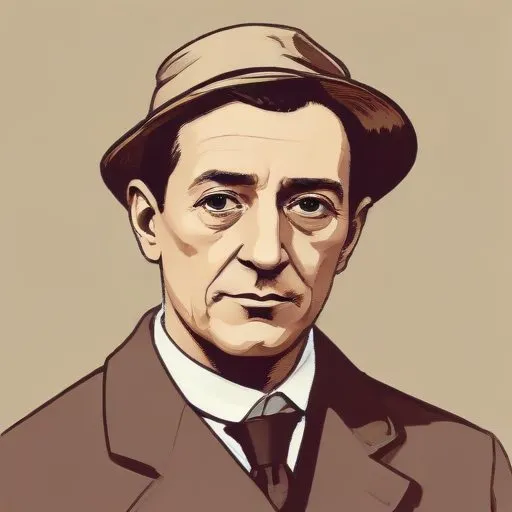
A pioneering naturalist who cataloged and illustrated numerous bird and insect species, making significant contributions to the fields of ornithology and entomology.
Regarded as the father of British ornithology, George Edwards (1694-1773) was a renowned English naturalist and ornithologist who made significant contributions to the field of natural history. Through his meticulous drawings and descriptions of birds, Edwards played a crucial role in establishing ornithology as a scientific discipline in Britain.
Born on April 3, 1694, in Stratford, Essex, Edwards was the son of a merchant. He received his early education at a boarding school in Leytonstone and later attended Brentwood Grammar School. Although his parents wanted him to pursue a career in commerce, Edwards' passion for natural history led him to travel extensively throughout Europe, studying and collecting specimens.
Edwards' artistic talents and attention to detail earned him recognition as a skilled natural history illustrator. His hand-colored etchings of birds and other animals were highly acclaimed, and he became a sought-after artist for his accurate and beautiful depictions of wildlife. Over a period of 21 years, Edwards published seven volumes of his work, containing descriptions and etchings of birds, with a total of 362 plates, 317 of which depicted birds.
The seven volumes of Edwards' work, comprising A Natural History of Uncommon Birds and Gleanings of Natural History, provide a comprehensive account of his research and discoveries. These publications not only showcased Edwards' artistic skills but also his dedication to documenting and preserving knowledge about the natural world.
Edwards' contributions to ornithology were instrumental in establishing the discipline as a reputable field of study. The Swedish naturalist Carl Linnaeus, considered the father of taxonomy, acknowledged Edwards' work and cited his descriptions and illustrations in his own publications, including the 10th and 12th editions of Systema Naturae. In 1757, Edwards was elected a fellow of the Royal Society, a testament to his remarkable contributions to the scientific community.
Edwards never married and dedicated his life to the pursuit of natural history. He died on July 23, 1773, at the age of 79, leaving behind a legacy as a pioneer in British ornithology. His work continues to inspire generations of naturalists, ornithologists, and artists, cementing his place as one of the most significant figures in the history of British natural history.
George Edwards' tireless dedication to the study of natural history and his extraordinary artistic talents have left an indelible mark on the field of ornithology. As the father of British ornithology, Edwards paved the way for future generations of naturalists and continues to inspire scientists and artists alike.
82 Years Old
A German-Canadian singer-songwriter, guitarist, and producer, known for his eclectic style blending rock, folk, and blues, and as the frontman of the rock band Steppenwolf. He's famous for hits like "Born to Be Wild" and "Magic Carpet Ride".
Born in 1635
Pioneering researcher of birds and fish, credited with developing a systematic approach to classification and description of species. His work laid the foundation for modern ornithology and ichthyology.
Born in 1617
A 17th-century English astrologer and politician who founded the Ashmolean Museum at Oxford University, collecting and preserving ancient artifacts and manuscripts. He's also known for his writings on alchemy and astrology.
Born in 1620
A 17th-century horticulturalist and writer who penned influential books on gardening, forestry, and architecture, shaping the English landscape and aesthetic. His works remain essential reading for garden enthusiasts and historians.
Born in 1640
An English chemist and academic who studied and wrote about alchemy, chemistry, and natural history, making significant contributions to the field of chemistry. He's also known for his work on the first comprehensive catalog of British fossils.
Born in 1660
A pioneering physician and collector who amassed a vast collection of natural history specimens and artifacts, laying the foundation for the British Museum.
Born in 1743
A British naturalist who sailed with Captain Cook on the HMS Endeavour, discovering and cataloging thousands of plant species, and advising on the development of the British colonies. He's considered the "father of Australian botany".
