


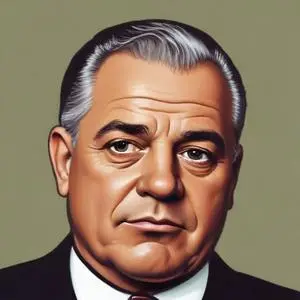
A pioneering labor leader who fought for workers' rights, leading the AFL-CIO and playing a key role in shaping American labor laws.
George Meany, a stalwart figure in American labor history, is renowned for his instrumental role in shaping the country's labor movement. As the first president of the AFL-CIO, he oversaw the merging of two major labor unions, leaving an indelible mark on the nation's industrial landscape.
Born on August 16, 1894, in Harlem, New York City, George Meany grew up in a family of plumbers. His father, Michael Meany, was a union plumber and president of his local plumbers' union, instilling in George the importance of labor organizing from a young age.
Meany followed in his father's footsteps, becoming a plumber's apprentice at 16 and earning his journeyman's certificate in 1917. He soon rose through the ranks, becoming a full-time union official 12 years later.
Meany's leadership skills and commitment to the labor movement earned him a spot as an officer of the American Federation of Labor (AFL). During World War II, he represented the AFL on the National War Labor Board, further solidifying his reputation as a shrewd negotiator and advocate for workers' rights.
In 1952, Meany became the president of the AFL, a position he held until 1955. His vision for a unified labor movement led him to propose a merger with the Congress of Industrial Organizations (CIO), which he successfully negotiated and oversaw the completion of in 1955.
As the first president of the AFL-CIO, Meany's leadership spanned 24 years, during which he worked tirelessly to promote the interests of American workers. His unwavering commitment to integrity, coupled with his strong anti-communist stance, earned him recognition as one of the most influential labor leaders of the 20th century.
Under Meany's guidance, the AFL-CIO grew to become a powerful voice in American politics, advocating for workers' rights, improved working conditions, and social justice. His leadership played a significant role in shaping the country's labor laws, including the passage of the Fair Labor Standards Act and the Civil Rights Act.
Meany's commitment to social justice and workers' rights was rooted in his deeply held beliefs about the importance of collective bargaining and the need for a strong labor movement. He famously stated, "Labor is not fighting for a larger slice of the pie - Labor is fighting for a larger pie."
Throughout his career, Meany exemplified the values of solidarity, fairness, and equality, inspiring generations of labor leaders and social activists.
In the midst of the Cold War, Meany's strong anti-communist stance positioned him as a leader in the fight against communist infiltration in the labor movement. His leadership during this period played a significant role in shaping the course of American labor history.
Meany's legacy extends beyond the AFL-CIO, as his commitment to social justice and workers' rights continues to inspire social and labor movements around the world.
As a testament to his enduring impact, the AFL-CIO headquarters in Washington, D.C. is named the George Meany Center in his honor.
George Meany's unwavering dedication to the labor movement and his unshakeable commitment to social justice have cemented his place as one of the most influential figures in American labor history.
Born in 1913
Leader of the International Brotherhood of Teamsters labor union, notorious for his mysterious disappearance and alleged ties to organized crime.
99 Years Old
Founded the United Farm Workers to improve working conditions and wages for farmworkers, leading boycotts and strikes to bring attention to their plight.
Born in 1912
A pioneering civil rights activist who played a key role in organizing the 1963 March on Washington, where Martin Luther King Jr. delivered his iconic "I Have a Dream" speech.
Born in 1889
Leader of the Brotherhood of Sleeping Car Porters, pioneering the Civil Rights Movement through nonviolent protests and advocacy for African American workers' rights.
97 Years Old
A prominent leader in the civil rights movement, advocating for racial equality and social justice through nonviolent means, leaving a lasting impact on American history.
Born in 1880
Led a powerful miners' union, fighting for workers' rights and fair wages, and was a key figure in shaping America's labor movement. Known for his charismatic leadership and militant tactics.
96 Years Old
Co-founder of the United Farm Workers, a labor union that fought for the rights of farmworkers, improving their working conditions and wages. Known for her tireless advocacy and grassroots organizing.
Born in 1850
Leading the American Federation of Labor, he fought for workers' rights, better wages, and improved working conditions, shaping the labor movement in the United States.
