


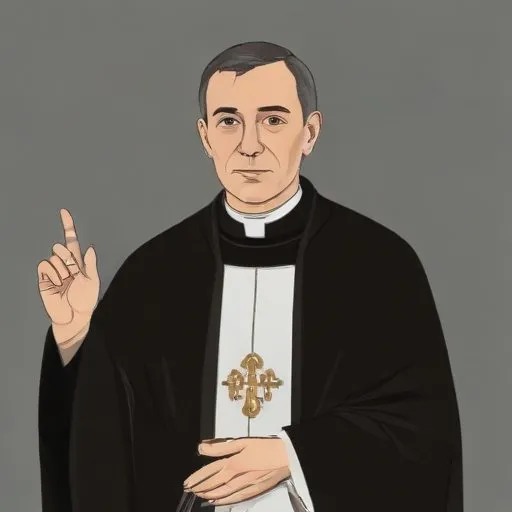
A German priest and reformer who played a key role in the Protestant Reformation, serving as a trusted advisor to Frederick the Wise and helping to facilitate Martin Luther's reforms. He's also known for his efforts to promote education and religious tolerance.
As the trusted secretary of the Saxon Elector Frederick the Wise, George Spalatin played a pivotal role in shaping the course of the Reformation, yet his contributions often fly under the radar. This German humanist, theologian, and reformer was more than just a behind-the-scenes figure, and his work had a profound impact on the development of Protestantism.
Born Georg Burkhardt on January 17, 1484, in Spalt, near Nuremberg, Germany, Spalatin came from a family of modest means. His father, a tanner, encouraged his education, and at the tender age of 13, Spalatin began his studies in Nuremberg. He later attended the University of Erfurt, where he earned his bachelor's degree in 1499.
In 1502, Spalatin caught the attention of Nikolaus Marschalk, a prominent professor at the University of Wittenberg. Marschalk took Spalatin under his wing, appointing him as his amanuensis, and introducing him to the world of humanism. This fateful connection would eventually lead Spalatin to become a key figure in the Reformation.
In 1505, Spalatin returned to Erfurt to study jurisprudence, where he befriended Conrad Mutianus, a leading figure among German humanists. Mutianus recognized Spalatin's talents and secured him a teaching position at the monastery in Georgenthal. This appointment paved the way for Spalatin's later roles as tutor, librarian, and secretary to Frederick the Wise.
In 1511, Spalatin was appointed as tutor to Frederick's nephews, including the future elector John Frederick. This position granted Spalatin unparalleled access to the Saxon court, and he soon became the elector's trusted advisor, librarian, and secretary. His mastery of Greek made him indispensable to the court, and his solid scholarship earned him a canons' stall in Altenburg.
Spalatin's unique blend of humanist and theological expertise made him an invaluable asset to the Saxon court. As a priest and preacher, he navigated the complexities of theology with ease, while his humanist background allowed him to approach Scripture with a critical and nuanced perspective. This synthesis of humanism and theology paved the way for a new generation of reformers.
Despite his significant contributions, Spalatin's legacy has often been overshadowed by his more famous contemporaries. However, his dedication to scholarship, his mastery of Greek, and his behind-the-scenes influence make him an unsung hero of the Reformation. As we delve into the complexities of this pivotal era, we would do well to remember the quiet brilliance of George Spalatin.
Born in 1483
A German monk and priest who sparked the Protestant Reformation, challenging Catholic Church authority and shaping Western Christianity. He's famous for nailing 95 theses to a church door, sparking a religious revolution.
Born in 1497
A 16th-century Renaissance scholar who made significant contributions to the development of the Protestant Reformation and education, known for his theological writings and astronomical observations.
Born in 1485
A key figure in the Protestant Reformation, he played a crucial role in shaping Lutheran theology and was a close advisor to Martin Luther. He's also known for his work in establishing the Lutheran Church in Denmark and Norway.
Born in 1493
A 16th-century Lutheran reformer and theologian who played a key role in shaping the Protestant Reformation, particularly in Germany. He's known for his translations of Luther's works and his own theological writings.
Born in 1498
A 16th-century theologian who sparked controversy by anonymously publishing a preface to Copernicus' De revolutionibus orbium coelestium, which led to a misunderstanding of the astronomer's heliocentric model. They also contributed to the development of Lutheran theology.
Born in 1509
A French pastor and theologian who played a key role in the Protestant Reformation, shaping Christian theology and influencing Western civilization. He's famous for his teachings on predestination and his role in establishing Calvinism.
Born in 1484
Leader of the Swiss Reformation, advocating for church reform and inspiring other Protestant movements.
Born in 1489
Leader of the English Reformation, instrumental in creating the Church of England and authoring the Book of Common Prayer.
