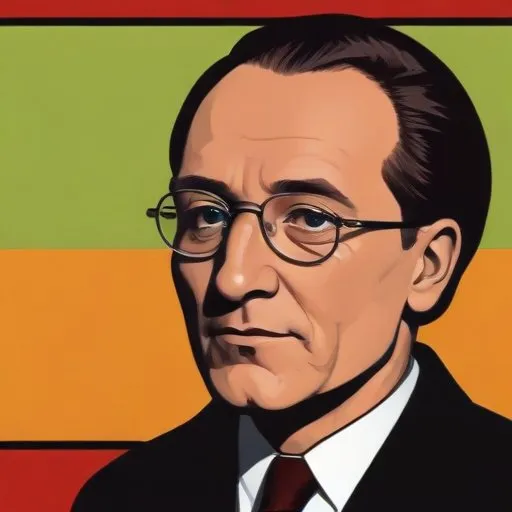
Gustav Landauer: The Revolutionary Theorist of Anarchism
A Champion of Social Anarchism and Nonviolent Resistance
Gustav Landauer was a prominent German philosopher, writer, and advocate of social anarchism, dedicated to promoting nonviolent noncooperation and social change through interpersonal relationships. His revolutionary ideas and actions had a profound impact on the anarchist movement in Germany during the late 19th and early 20th centuries.
Early Life and Career
Born on April 7, 1870, in Karlsruhe, Germany, Landauer was the second child of Jewish parents Rosa and Herman Landauer. Growing up, he was heavily influenced by the works of individualist anarchists such as
Max Stirner and
Friedrich Nietzsche. However, he soon cautioned against the potential pitfalls of unchecked individualism, emphasizing the importance of solidarity and interpersonal relationships.
Rise to Prominence and Key Contributions
Landauer's advocacy for social anarchism led him to become a close collaborator with prominent figures like
Martin Buber, influencing the latter's philosophy of dialogue. He believed that true socialism could only arise through a revolution in interpersonal relationships, and wrote extensively on the subject. His most notable work,
Social Revolution, outlined his vision for a decentralized, stateless society.
Translation and Literary Contributions
Landauer was also a prolific translator, rendering
William Shakespeare's and
Peter Kropotkin's works into German. His translations played a significant role in introducing these influential thinkers to a broader German audience.
Commissioner of Enlightenment and Public Instruction
In 1919, Landauer briefly served as Commissioner of Enlightenment and Public Instruction in the short-lived Bavarian Soviet Republic during the German Revolution of 1918-1919. Although his tenure was cut short, his commitment to education and social enlightenment remained unwavering.
Assassination and Legacy
Tragically, Landauer's life was cut short by right-wing paramilitary Freikorps soldiers on May 2, 1919, during the suppression of the Bavarian Soviet Republic. Despite his untimely death, Landauer's philosophical contributions and influence on modern anarchism continue to inspire and shape social movements to this day.
Influence on Modern Society
Landauer's emphasis on nonviolent resistance and social change through interpersonal relationships has inspired various social movements, including the Occupy Wall Street protests and the Arab Spring. His ideas continue to influence contemporary debates on anarchism, socialism, and social justice.
Quotes and Memorable Sayings
- "The community we long for and need, we will find only if we sever ourselves from individuated existence."
- "Thus we will at last find, in the innermost core or our hidden being, the most ancient and most universal community – the human race and the cosmos."
Historical Context and Comparative Analysis
Landauer's work must be understood within the context of early 20th-century German politics and the rise of anarchism as a distinct philosophical movement. His contemporaries, such as Errico Malatesta and
Pierre-Joseph Proudhon, shared similar concerns and ideologies. Landauer's unique contribution lay in his emphasis on interpersonal relationships and nonviolent resistance as essential components of social change.
Personal Relationships and Anecdotes
Landauer's close friendship with Martin Buber had a profound impact on the development of Buber's philosophy of dialogue. The two intellectuals often engaged in lively debates and discussions, shaping each other's thoughts on social justice and human relationships.
Impact on Pop Culture
Landauer's ideas have influenced various artistic and cultural movements, including the German Expressionist movement and the avant-garde art of the early 20th century. His commitment to social change and nonviolent resistance continues to inspire artists, writers, and musicians today.
Educational Contributions and Influence
Landauer's philosophical contributions have had a lasting impact on educational thought, emphasizing the importance of interpersonal relationships, nonviolent resistance, and social change. His ideas continue to influence contemporary debates on education and social justice.
Final Thoughts and Legacy
Gustav Landauer's life and work serve as a powerful testament to the enduring power of nonviolent resistance and social anarchism. His commitment to education, social change, and human relationships continues to inspire and shape our understanding of social justice today.
FAQ
What were Gustav Landauers contributions to anarchist theory?
Gustav Landauer made significant contributions to anarchist theory, particular in the areas of social organization and community building. He was known for his concept of social anarchism, which emphasized the importance of community and mutual aid.
How did Gustav Landauers work impact German anarchism?
Gustav Landauers work had a profound impact on German anarchism, as he helped to establish anarchism as a major political movement in Germany. He was a pioneer in the development of anarchist theory and practice in Germany.
What was Gustav Landauers role in the German Revolution of 1918-1919?
Gustav Landauer played a key role in the German Revolution of 1918-1919, serving as the Minister of Culture in the Revolutionary Government of Bavaria. He was a strong advocate for social and political change.
What were Gustav Landauers views on nationalism?
Gustav Landauers views on nationalism were shaped by his anarchist and pacifist beliefs. He was a strong critic of nationalism, believing that it led to war, conflict, and social division.
How is Gustav Landauer remembered in Germany today?
Gustav Landauer is remembered in Germany today as a pioneering figure in anarchist theory and practice, a champion of social justice and community building, and a passionate advocate for social and political change. His legacy continues to inspire Germans, and his work remains an important part of German cultural heritage.