


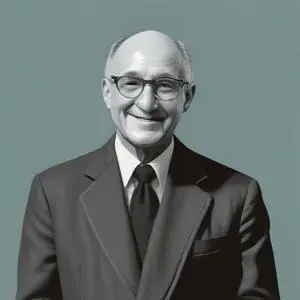
Developed the Modern Portfolio Theory, a groundbreaking concept in finance that helps investors optimize returns while minimizing risk. This work revolutionized the field of financial economics.
Harry Markowitz is renowned for his groundbreaking work in modern portfolio theory, which revolutionized the way investors approach risk management and asset allocation. His pioneering research has enabled investors to maximize returns while minimizing risk, earning him the Nobel Memorial Prize in Economic Sciences in 1990.
Born on August 24, 1927, to a Jewish family in Chicago, Illinois, Markowitz developed an interest in physics and philosophy during his high school years. He pursued his undergraduate studies at the University of Chicago, where he earned his Ph.B. in Liberal Arts in 1947. Markowitz's fascination with economics led him to continue his studies at the University of Chicago, earning his A.M. in Economics in 1950.
Markowitz's doctoral research focused on applying mathematics to the analysis of the stock market. Under the guidance of Jacob Marschak, he realized that the then-prevailing theory of stock prices lacked an analysis of risk. This insight led to the development of his seminal theory of portfolio allocation under uncertainty, published in 1952 by the Journal of Finance.
Markowitz's work is deeply rooted in his fascination with philosophy, particularly the ideas of David Hume. His research reflects a philosophical approach to understanding human behavior in the context of investment decisions.
Markowitz's modern portfolio theory has had a profound impact on the investment landscape. His work has influenced the development of asset management strategies, risk management practices, and financial modeling techniques.
Markowitz's academic and professional achievements are complemented by his personal milestones, including his marriage to Barbara, with whom he has two children, and his passion for classical music and piano playing.
Harry Markowitz's pioneering work has left an indelible mark on the field of finance. His modern portfolio theory has become a cornerstone of investment decision-making, and his influence continues to shape the development of financial economics.
Harry Markowitz's remarkable journey is a testament to the power of innovative thinking and dedicated research. His legacy continues to inspire generations of economists, financial professionals, and investors, cementing his place as one of the most influential economists of the 20th century.
Born in 1912
A Nobel Prize-winning economist who championed free market capitalism and limited government intervention, known for his advocacy of laissez-faire economics and influential writings on monetary policy.
Born in 1883
A pioneering economist who revolutionized modern economic theory with his groundbreaking ideas on government intervention and fiscal policy, shaping global economic policies.
Born in 1915
A renowned economist and academic who made significant contributions to the field of economics, particularly in the areas of macroeconomics and international trade. He was awarded the Nobel Prize in Economics in 1970.
83 Years Old
A Nobel Prize-winning economist and academic who has made significant contributions to the field of economics, particularly in the areas of information economics and globalization.
92 Years Old
A renowned economist and philosopher who has made significant contributions to welfare economics, social choice theory, and development economics, and is known for his work on poverty, famine, and human development.
Born in 1920
Developed econometric models that accurately predicted economic trends and fluctuations, earning him the Nobel Prize in Economics in 1980.
Born in 1924
A Nobel Prize-winning economist who developed a growth model that showed technological progress is the primary driver of economic growth, and is known for his work on the theory of economic growth.
Born in 1918
Developed the life-cycle hypothesis, which explains how people save and spend money over their lifetimes, and made significant contributions to the field of macroeconomics.
