


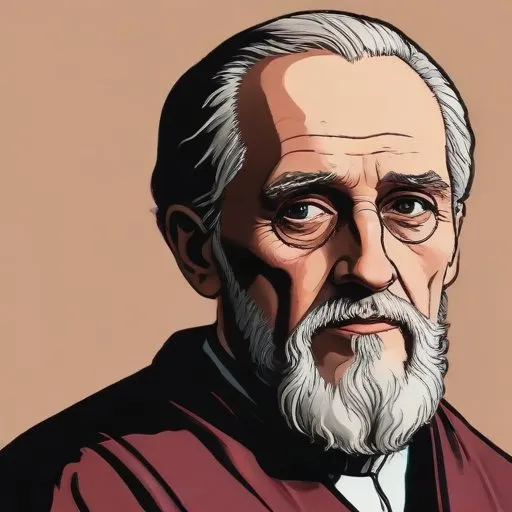
A prominent figure in the history of philosophy, this individual contributed significantly to the development of idealist philosophy and wrote extensively on the philosophy of religion. They also served as a prominent educator and administrator at Oxford University.
Hastings Rashdall was a renowned English philosopher, theologian, historian, and Anglican priest, best known for his groundbreaking work in ideal utilitarianism and his comprehensive historical study of the universities of the Middle Ages.
Rashdall's magnum opus, The Theory of Good and Evil (1907), is a seminal work that expounds his unique version of utilitarianism, which prioritizes the concepts of good and value over right. He drew inspiration from his teachers, T. H. Green and Henry Sidgwick, and his ideas were later eclipsed by G. E. Moore's Principia Ethica (1903). Rashdall's philosophy revolves around the belief that the ideal of human life is a harmonious whole, where each good is made distinct by the presence of others.
Rashdall's historical study, The Universities of Europe in the Middle Ages, is a landmark work that has secured its place in intellectual history. This comprehensive and comparative study of medieval universities has been hailed as a foundational text in the field, and its scope and breadth continue to influence historians and scholars to this day.
Born in Kensington, London on June 24, 1858, Rashdall was the son of an Anglican priest. He received a scholarship to New College, Oxford, and later held positions at St Davids University College and University College, Durham. Rashdall was a Fellow of Hertford College, Oxford, and later New College, Oxford, where he dedicated his life to philosophical and historical inquiry.
Rashdall's philosophical and historical contributions have had a lasting impact on modern society. His ideas on ideal utilitarianism have influenced moral philosophers and theorists, while his historical study of medieval universities has shaped our understanding of the development of education and intellectual thought.
"The ideal of human life is not the mere juxtaposition of distinct goods, but a whole in which each good is made different by the presence of others."
Rashdall's work was instrumental in shaping the intellectual landscape of the early 20th century. His philosophical and historical contributions continue to be studied and debated by scholars today, solidifying his legacy as a pioneering thinker of his time.
Through his remarkable body of work, Hastings Rashdall has left an indelible mark on the fields of philosophy, history, and theology. His ideas and contributions continue to inspire and influence scholars, ensuring his place as a revered figure in intellectual history.
Born in 1801
A leading figure in the Oxford Movement, he was a prominent theologian and philosopher who converted to Catholicism, influencing Christian thought and education. He's also known for his poetry and hymns.
Born in 1768
A pioneering theologian and philosopher who shaped modern Christian thought and hermeneutics, known for his emphasis on individual experience and understanding of religious texts.
Born in 1770
A German philosopher and academic who developed a comprehensive and systematic philosophy that emphasized the unity of all things and the dialectical process of thesis, antithesis, and synthesis. His ideas have had a profound impact on modern thought, influencing fields such as philosophy, politics, and art.
Born in 1806
A prominent 19th-century thinker who championed individual liberty, free speech, and women's rights, and is best known for his influential book "On Liberty".
Born in 1838
A pioneering utilitarian philosopher and economist who developed influential theories on ethics, morality, and welfare economics, shaping modern thought on these subjects.
Born in 1861
Developed groundbreaking philosophical concepts, such as process philosophy, and contributed significantly to mathematics, particularly in the fields of logic and geometry.
Born in 1872
A renowned thinker who made significant contributions to mathematics, philosophy, and social commentary, known for his influential writings on logic, ethics, and politics. He's a prominent figure in shaping modern intellectual thought.
