


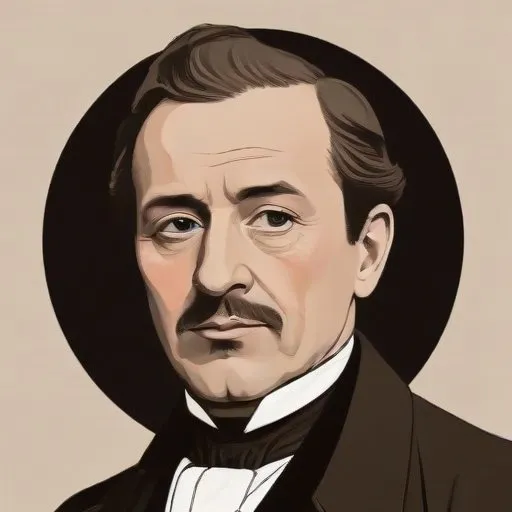
A 19th-century French historian and statesman who wrote influential works on the French Revolution and served as Minister of Education, implementing significant reforms in the French education system.
HenriAlexandre Wallon was a French historian and statesman who played a pivotal role in shaping the country's Third Republic. Known as the "Father of the Republic," Wallon's tireless efforts led to the creation of a new government, earning him a revered place in French history.
Born on December 23, 1812, in Valenciennes, Nord, Wallon's love for literature and history drove him to become a professor at the École Normale Supérieure in 1840, under the patronage of Guizot. In 1846, he succeeded Guizot as professor at the Faculté des Lettres.
Wallon's work on slavery in the French colonies (1847) and slavery in antiquity (1848) caught the attention of the French government, leading to his appointment on a commission to regulate labor in the French colonies. His dedication to ending slavery in France's colonies solidified his reputation as a champion of human rights.
In 1849, Wallon was elected to the Legislative Assembly by the department of the Nord, where he played a crucial role in shaping the country's policies. Although he resigned in 1850, disapproving of the measure to restrict suffrage, he remained committed to public service, eventually becoming a member of the Académie des Inscriptions in 1850 and its perpetual secretary in 1873.
Wallon's literary works are a testament to his dedication to history. His biography, Richard II, épisode de la rivalité de la France et de l'Angleterre (1864), is a seminal work that showcases his historical expertise. He also penned Jeanne d'Arc (1860), La Vie de Notre Seigneur Jésus (1865), and Saint Louis et son temps (1871), which remain influential in the field of hagiography.
Following the Franco-Prussian War, Wallon returned to politics in 1871, re-elected by the department of the Nord. He continued to play a pivotal role in the Assembly, ultimately immortalizing himself by carrying the proposition for the establishment of the Third Republic.
Today, HenriAlexandre Wallon is remembered as a champion of human rights, a dedicated historian, and the father of the French Third Republic. His contributions to French history are a testament to his unwavering commitment to public service and his unrelenting passion for creating a more just society.
Wallon's grandson, Henri Wallon, went on to become a renowned psychologist and politician, cementing the Wallon family's legacy in French politics and academia.
HenriAlexandre Wallon's contributions to the abolition of slavery, his tireless efforts to establish the Third Republic, and his dedication to public service have inspired generations of French politicians and historians. His legacy continues to shape French politics and society, solidifying his place as one of the most influential figures in French history.
Born in 1798
A 19th-century French historian and philosopher who pioneered a new approach to historical writing, focusing on the lives and experiences of ordinary people, rather than just monarchs and elites. He's also known for his vivid and poetic writing style.
Born in 1787
A 19th-century French historian and politician who served as Prime Minister, known for his role in shaping France's modern democracy and educational system.
Born in 1811
The son of Napoleon Bonaparte, he was the titular Emperor of the French from 1811 to 1832, although he never actually ruled. He's known for his brief, tumultuous life and mysterious death.
Born in 1790
A 19th-century French poet and politician who served as the country's Head of State, known for his romantic poetry and instrumental role in the French Revolution of 1848.
Born in 1805
A 19th-century French historian and philosopher who traveled to America to study its democracy, producing a seminal work on the country's political and social structures. He's known for his insightful commentary on the American experiment and its implications for modern democracy.
