


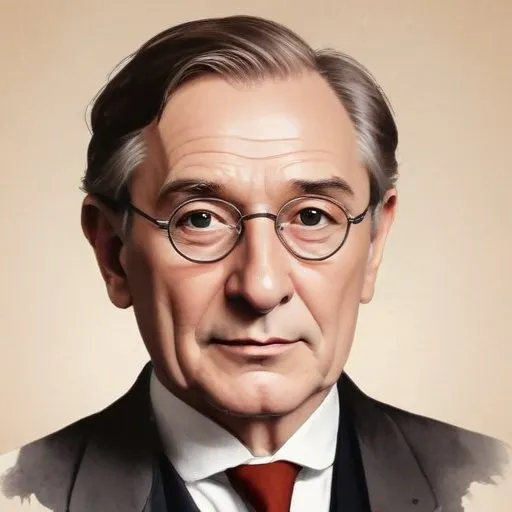
A Belgian lawyer and author who was awarded the Nobel Peace Prize in 1913 for his efforts to establish the International Committee of the Red Cross and promote international law and arbitration. He is also known for his work in promoting peace and disarmament.
Henri La Fontaine, a Belgian international lawyer, is renowned for his instrumental role in promoting peace and justice globally, earning him the Nobel Prize for Peace in 1913. As the effective leader of the peace movement in Europe, La Fontaine's tireless efforts paved the way for international cooperation and conflict resolution.
Born on April 22, 1854, in Brussels, Belgium, La Fontaine pursued his academic interests in law at the Free University of Brussels (now split into the Université libre de Bruxelles and the Vrije Universiteit Brussel). After completing his studies, he was admitted to the bar in 1877 and soon established himself as an authority on international law.
La Fontaine, along with his sister Léonie La Fontaine, were early advocates for women's rights and suffrage. In 1890, they founded the Belgian League for the Rights of Women, a groundbreaking initiative that contributed significantly to the advancement of women's rights in Belgium.
In 1893, La Fontaine became a professor of international law at the Free University of Brussels, imparting his expertise to future generations. His commitment to public service led him to be elected to the Belgian Senate as a member of the Socialist Party in 1895. He went on to serve as the vice chairman of the Senate from 1919 to 1932.
La Fontaine's involvement with the International Peace Bureau, founded in 1882, was instrumental in facilitating the Hague Peace Conferences of 1899 and 1907. He served as the president of the Bureau from 1907 until his death in 1943, dedicated to promoting international cooperation and conflict resolution.
The devastation of World War I convinced La Fontaine that the world needed an international court to resolve disputes peacefully. He proposed a number of esteemed individuals, including Joseph Hodges Choate, Elihu Root, Charles William Eliot, and Andrew Dickson White, to be part of this endeavor.
La Fontaine was a strong advocate for unifying pacifist organizations worldwide. He also founded the Centre Intellectuel Mondial, which later merged with the League of Nations Institute for Intellectual Cooperation. Additionally, he proposed the establishment of a world school, university, and parliament to promote global understanding and cooperation.
La Fontaine's relentless pursuit of peace and justice earned him the Nobel Prize for Peace in 1913. He was also a member of the Belgian delegation to the Paris Peace Conference in 1919 and to the League of Nations Assembly from 1920 to 1921.
Henri La Fontaine's tireless efforts to promote international peace and justice continue to inspire generations. His pioneering work in international law, women's rights, and pacifist movements has left an indelible mark on the world. As a champion of peace, La Fontaine's legacy serves as a beacon of hope for a more harmonious and just world.
La Fontaine's wisdom and vision are reflected in his words: "The great importance of some kind of international tribunal is that it will prevent war." His commitment to peace and justice continues to resonate with people around the world.
Henri La Fontaine's remarkable life and achievements serve as a testament to his unwavering dedication to peace, justice, and human rights. His legacy continues to inspire future generations to strive for a more harmonious and peaceful world.
Born in 1843
A pioneering pacifist and writer, she championed international disarmament and peace, earning the first Nobel Peace Prize awarded to a woman. Her groundbreaking work inspired a generation of peace activists.
Born in 1822
A French economist and academic who was awarded the Nobel Peace Prize in 1901 for his efforts to establish the International Committee of the Red Cross and promote international arbitration. He is known for his pioneering work in promoting peace and conflict resolution.
Born in 1851
A French police officer turned politician who served as Prime Minister of France and was awarded the Nobel Peace Prize for his efforts to establish the International Court of Arbitration. He championed international cooperation and peace.
Born in 1833
A pioneering pacifist and women's rights advocate, she dedicated her life to promoting international peace and unity, earning her the Nobel Peace Prize in 1902.
Born in 1843
A Swiss lawyer and politician who worked tirelessly to promote international arbitration and peace, earning him the Nobel Peace Prize in 1902. He's most known for his efforts to establish the International Committee of the Red Cross.
Born in 1837
A Danish lieutenant and politician who worked tirelessly to promote international arbitration and disarmament, earning him the Nobel Peace Prize in 1908. He's a pioneering figure in the development of modern peace movements.
Born in 1833
An Italian soldier and journalist who was awarded the Nobel Peace Prize in 1907 for his efforts to promote international arbitration and disarmament. He's known for his pacifist activism and writings.
