


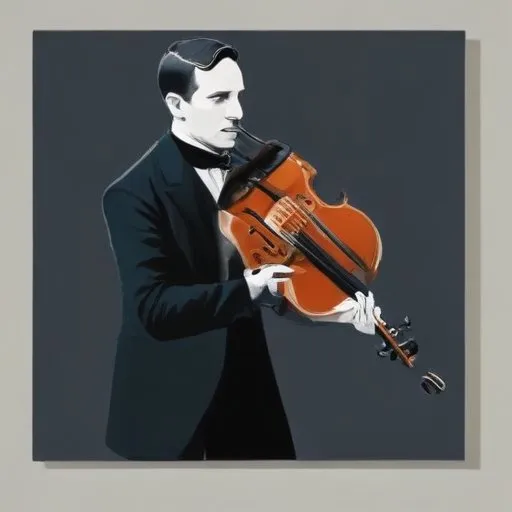
A virtuosic violinist and composer, renowned for his technically demanding and expressive works that expanded the violin repertoire. His compositions still inspire and challenge musicians today.
Henri Vieuxtemps, a Belgian composer and violinist, occupies a prominent place in the history of the violin, exemplifying the Franco-Belgian violin school during the mid-19th century. He is renowned for his exceptional mastery of the instrument, particularly with the illustrious Vieuxtemps Guarneri del Gesu, a violin of superior craftsmanship.
Born on February 17, 1820, in Verviers, Belgium, Vieuxtemps was the son of a weaver and amateur violinist and violin maker. His father, recognizing his son's musical aptitude, provided him with his first violin lessons. Vieuxtemps' prodigious talent was evident from an early age, making his public debut at six, performing a concerto by Pierre Rode.
Vieuxtemps' meeting with Charles Auguste de Bériot, a prominent violinist, marked the beginning of his formal training. Bériot took Vieuxtemps to Paris, where he made a successful concert debut in 1829. Although the July Revolution disrupted his Parisian sojourn, Vieuxtemps continued to develop his skills, eventually touring Germany and befriending influential musicians like Louis Spohr and Robert Schumann, who likened him to Niccolò Paganini.
Vieuxtemps' aspiration to become a composer led him to study with Simon Sechter in Vienna and later with Anton Reicha in Paris. His first violin concerto, published in 1837, showcased his compositional prowess. Throughout his career, Vieuxtemps wrote numerous works, including concertos, chamber music, and solo pieces, demonstrating his mastery of various genres.
Vieuxtemps' virtuosity impressed prominent musicians, including Hector Berlioz and Niccolò Paganini. He collaborated with celebrated artists, such as the mezzo-soprano Pauline Viardot, and performed in various European cities, solidifying his reputation as a leading violinist and composer.
Vieuxtemps' contributions to the violin repertoire and his influence on subsequent generations of violinists are undeniable. His Guarneri del Gesu violin, now known as the Vieuxtemps Guarneri, remains an iconic instrument, symbolizing his artistic excellence. Today, Vieuxtemps is remembered as a trailblazer in the Franco-Belgian violin school, leaving an indelible mark on the world of classical music.
Born in 1782
A virtuosic violinist and composer who revolutionized the instrument's technical possibilities, leaving an indelible mark on classical music.
Born in 1833
A renowned pianist and composer, he crafted complex, expressive works that blended traditional and innovative techniques, leaving an indelible mark on classical music.
Born in 1678
A virtuosic violinist and prolific composer, he crafted over 400 concertos, including "The Four Seasons," which remains a beloved and iconic masterpiece of classical music.
Born in 1756
A child prodigy and master of classical music, he composed over 600 works, including symphonies, operas, and chamber music, that continue to inspire and influence musicians today.
Born in 1770
A musical genius who expanded the possibilities of classical music, creating iconic symphonies and piano sonatas that continue to inspire and influence generations of artists.
Born in 1809
A renowned 19th-century musician who masterfully blended classical and romantic styles, creating iconic works like the "Wedding March" and "Elijah" oratorio. His compositions continue to inspire and influence generations of artists.
Born in 1810
A renowned Romantic-era composer and influential music critic, known for his expressive and emotionally charged works, including symphonies, piano music, and art songs.
Born in 1901
A virtuosic violinist renowned for his technical perfection, tone, and phrasing, revolutionizing the art of violin playing through his recordings and teaching.
