


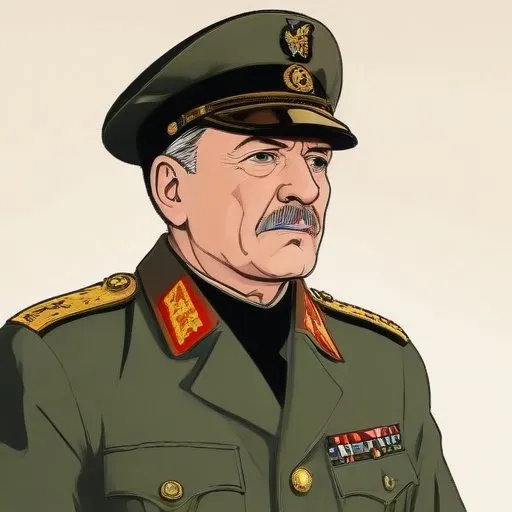
A German general who led elite paratroop forces during World War II, known for his bravery and tactical genius in battles like Crete and North Africa.
Hermann Bernhard Ramcke was a renowned German general of paratroop forces during World War II, known for his bravery and tactical prowess in various battles across Europe and Africa. He is one of only 27 recipients of the Knights Cross of the Iron Cross with Oak Leaves, Swords, and Diamonds, the highest military honor in Nazi Germany.
Born on January 24, 1889, Ramcke joined the Imperial German Navy in 1905 and served during World War I. He fought in the West with the Marine-Infanterie, mainly in the area of Flanders, and was decorated with the Iron Cross second class and later the Iron Cross first class.
After the war, Ramcke fought against the Bolshevik forces in the Baltic region as a member of the Russian Army of the West, composed mostly of German veterans. He stayed in the Reichswehr during the Weimar Republic period and continued to serve in the new Wehrmacht, attaining the rank of Oberstleutnant in 1937.
On July 19, 1940, Ramcke was transferred to the 7th Flieger Division under the command of General Kurt Student and was promoted to Oberst. He led units in Crete, North Africa, Italy, the Soviet Union, and France, earning a reputation as a skilled and fearless commander.
However, Ramcke's military career was also marred by allegations of war crimes, particularly during the fighting on Crete in 1941, where he ordered his men to attack civilians as punishment for guerrilla attacks. He was also convicted of war crimes against French civilians during the Battle for Brest in 1944.
Throughout his military career, Ramcke received numerous awards and decorations, including:
After the war, Ramcke was captured by American forces and imprisoned for nearly five years. In 1951, he was convicted of war crimes and sentenced to prison, but was released after three months due to time served.
In the 1950s, Ramcke became a prominent nationalist and supported extreme right-wing movements, sparking controversy and criticism from many quarters.
Hermann Bernhard Ramcke's military career was marked by both bravery and controversy. While he was a decorated and respected commander, his involvement in war crimes and support for extreme right-wing ideologies have tarnished his legacy.
Despite his flaws, Ramcke's military accomplishments and decorations remain a testament to his skills as a commander, and his story serves as a reminder of the complexities and nuances of human nature, even in the face of war and conflict.
Born in 1891
A renowned World War II military strategist, known for leading the Afrika Korps and earning the respect of both allies and enemies with his tactical genius.
Born in 1907
A German general who led a parachute unit during World War II, known for his daring operations behind enemy lines, including a famous raid in Belgium.
Born in 1893
A high-ranking Nazi official, he was a decorated World War I fighter pilot and later became a prominent politician, serving as Minister President of Prussia. He's infamous for his role in the Nazi regime and war crimes trials.
Born in 1888
A pioneering tank commander who revolutionized modern warfare with his innovative blitzkrieg tactics, earning him the nickname "Father of the Panzerwaffe".
Born in 1891
A skilled and highly decorated military leader, known for his tactical genius and defensive strategies during World War II, earning him the respect of both his allies and enemies.
Born in 1892
A highly decorated Luftwaffe pilot and commander, known for being the last commander of the Luftwaffe during World War II and flying Hitler out of Berlin in 1945.
