


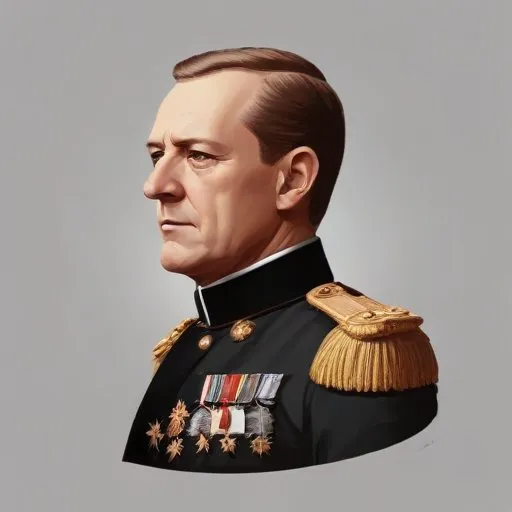
A German general who led a parachute unit during World War II, known for his daring operations behind enemy lines, including a famous raid in Belgium.
Friedrich August Freiherr von der Heydte was a renowned German paratroop officer who played a pivotal role in World War II, and later, a prominent academic and politician in West Germany. He is best known for his exceptional military prowess, earning the rank of General, and his contributions to the fields of political science and international law.
Von der Heydte was born on March 30, 1907. He began his military career in April 1925, joining the Reichswehr, before pursuing higher education at Innsbruck University, where he earned a degree in economics in 1927. He furthered his studies at Graz University, receiving a degree in law in the same year.
In 1933, von der Heydte embarked on his academic career in international law, serving as a private assistant to Hans Kelsen in Cologne. Following Kelsen's dismissal, he became an assistant to Alfred Verdross at the Consular Academy in Vienna (1933-1934). He later worked with Karl Gottfried Hugelmann at the University of Münster, solidifying his expertise in international law.
Von der Heydte participated in the invasion of Poland and the Battle of France as a junior commander. In May 1940, he was transferred to the Luftwaffe's parachute arm, commanding a battalion during the Battle of Crete in May 1941. He went on to lead the Fallschirm Lehrbattalion in Libya as part of the Ramcke Parachute Brigade (July 1942). Von der Heydte served as an officer in the Ramcke Brigade in North Africa until February 1943, when he was transferred to France to form the nucleus of the new 2nd Fallschirmjäger Division.
Following the war, von der Heydte pursued academic, political, and military careers. He became a Catholic-conservative professor of political science, a member of the Christian Social Union political party, and a Bundeswehr reservist. In 1962, he was involved in the Spiegel affair, a significant controversy surrounding the German government's handling of a news article.
Von der Heydte's legacy is marked by his multifaceted contributions to military strategy, academic discourse, and political sphere. His experiences during World War II and post-war careers served as a testament to his adaptability, strategic thinking, and dedication to serving his country.
Von der Heydte's extensive experience in military strategy, academia, and politics allowed him to make significant contributions to post-war West Germany. His career serves as a fascinating case study, offering valuable insights into the complexities of military leadership, the development of international law, and the intricacies of politics in the 20th century. A comparative analysis with contemporaries, such as Hans-Jürgen von Arnim and Theodor Bücker, would provide further context into von der Heydte's achievements and the broader historical landscape.
Born in 1887
A highly decorated military strategist who played a crucial role in several key battles during World War II, including the invasion of France and the Siege of Leningrad.
Born in 1888
A pioneering tank commander who revolutionized modern warfare with his innovative blitzkrieg tactics, earning him the nickname "Father of the Panzerwaffe".
Born in 1880
A German field marshal who led the Wehrmacht during World War II, playing a key role in the invasion of Poland and the Battle of Moscow. He was a prominent figure in the German high command during the war.
Born in 1881
A German field marshal who played a crucial role in the Nazi war effort, serving as the commander-in-chief of the German Army from 1938 to 1941. He was a key figure in the invasion of Poland and the Battle of France.
Born in 1882
A high-ranking Nazi officer who served as the Chief of the OKW, the German High Command, during World War II, and was known for his unwavering loyalty to Hitler. He was tried and executed for war crimes after the war.
Born in 1890
Chief of the German High Command during World War II, responsible for planning and executing military operations, and signing the unconditional surrender of Germany.
Born in 1891
A German naval commander who led the U-boat fleet during World War II and briefly served as President of Germany after Hitler's death, known for his role in the war and its aftermath.
Born in 1876
A German naval leader who played a key role in the Kriegsmarine during World War II, overseeing the German U-boat fleet and naval operations. He was a close advisor to Adolf Hitler and implemented the German naval strategy during the war.
