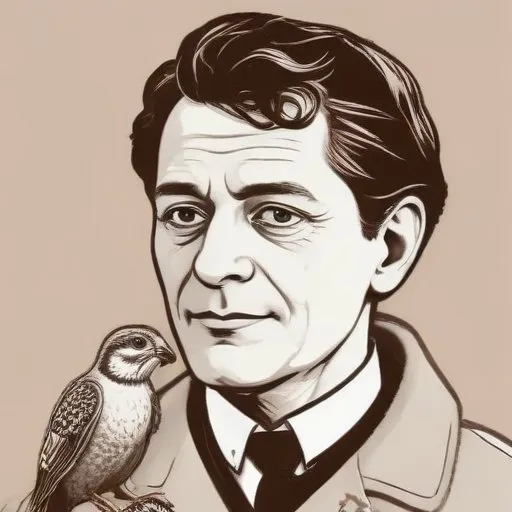
Hermann Schlegel: The Pioneering Ornithologist and Ichthyologist
A Legendary Career in Zoology
Hermann Schlegel is renowned for his groundbreaking contributions to the field of zoology, particularly in ornithology, herpetology, and ichthyology. As a German naturalist, he dedicated his life to the study and classification of birds, reptiles, and fish, leaving an indelible mark on the scientific community.
Early Life and Education
Born on June 10, 1804, in Altenburg, Germany, Schlegel's fascination with natural history was ignited by his father's butterfly collection. This childhood interest led him to pursue a career in zoology, with a chance discovery of a buzzard's nest sparking his passion for ornithology. In 1824, Schlegel traveled to Vienna, where he attended lectures by esteemed naturalists
Leopold Fitzinger and Johann Jacob Heckel, further solidifying his foundation in the field.
Rise to Prominence
Schlegel's big break came when
Christian Ludwig Brehm introduced him to Joseph Natterer, securing him a position at the Naturhistorisches Museum in Vienna. His exceptional skills and dedication earned him a recommendation from Carl Franz Anton Ritter von Schreibers to
Coenraad Jacob Temminck, director of the natural history museum of Leiden. In 1826, Schlegel joined Temminck's team, initially focusing on the reptile collection, but soon expanding his scope to encompass other zoological groups.
Collaborations and Contributions
Schlegel's collaboration with
Philipp Franz von Siebold on
Fauna Japonica (1845-1850) remains a seminal work in the field of zoology. This monumental publication showcased the duo's expertise in describing and classifying species from Japan, earning them international recognition. Schlegel's own publications, such as
Essai sur la Physionomie des Serpens (1837), demonstrated his unique approach to species classification and description.
Opposition to Darwin's Theory
Notably, Schlegel was a vocal critic of
Charles Darwin's theory of evolution by natural selection. His belief in fixed species and opposition to Darwin's ideas led to a divergence in opinions among naturalists of the time.
Legacy and Honors
Schlegel's tireless efforts earned him numerous accolades, including his appointment as a correspondent of the Royal Institute of the Netherlands in 1847 and his membership in the Royal Netherlands Academy of Arts and Sciences in 1851. His contributions to the field of zoology have been remembered and revered, with many species bearing his name in honor of his discoveries.
Personal Milestones and Key Life Events
- 1804: Born on June 10th in Altenburg, Germany
- 1824: Traveled to Vienna to attend lectures by Leopold Fitzinger and Johann Jacob Heckel
- 1826: Joined the Naturhistorisches Museum in Vienna
- 1837: Published Essai sur la Physionomie des Serpens
- 1845-1850: Collaborated with Philipp Franz von Siebold on Fauna Japonica
- 1847: Became correspondent of the Royal Institute of the Netherlands
- 1851: Became a member of the Royal Netherlands Academy of Arts and Sciences
- 1884: Passed away on January 17th
Trivia and Fun Facts
- Schlegel's meeting with Christian Ludwig Brehm, a prominent ornithologist, played a significant role in shaping his career.
- He was initially intended to join the Natural History Commission in Java, but the project was cancelled due to Heinrich Boie's untimely death.
- Schlegel's extensive collection of zoological specimens is housed at the Naturalis Biodiversity Center in Leiden, Netherlands.
Schlegel's remarkable contributions to the field of zoology have left a lasting impact on our understanding of the natural world. His dedication to the study and classification of species has inspired generations of naturalists and scientists, cementing his place as one of the most prominent figures in the history of ornithology and ichthyology.
FAQ
What were Hermann Schlegels contributions to ornithology and herpetology?
Hermann Schlegel was a German ornithologist and herpetologist who made significant contributions to the study of birds and reptiles, particularly in his work on the taxonomy and classification of species.
What was Hermann Schlegels role in the discovery of new species?
Schlegel discovered numerous new species of birds and reptiles during his expeditions to Africa, Asia, and South America. His discoveries greatly expanded our understanding of the natural world and its biodiversity.
What was Hermann Schlegels role in the development of the natural history museum in Leiden?
Schlegel played a key role in the development of the natural history museum in Leiden, Netherlands, where he worked as a curator and director. He helped to build the museums collections and establish it as a center for scientific research.
What were some of Hermann Schlegels notable writings?
Schlegel wrote several notable works on ornithology and herpetology, including Revue méthodique et critique des collections de Mammifères et dOiseaux du Musée des Pays-Bas and Monographie des Géopélides. His writings provided significant insights into the biology and behavior of birds and reptiles.
How did Hermann Schlegels work impact the development of natural history?
Schlegels work had a lasting impact on the development of natural history, particularly in the fields of ornithology and herpetology. His discoveries and writings helped to expand our understanding of the natural world and its diverse species.