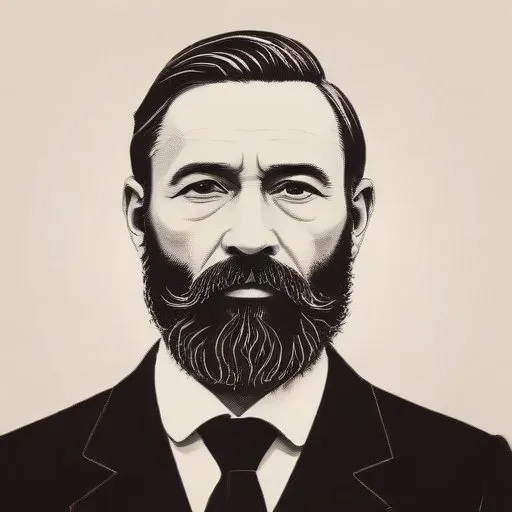
Leopold Fitzinger: The Pioneering Austrian Zoologist
A Legacy in Herpetology and Zoological Classification
Leopold Fitzinger, an Austrian zoologist, is renowned for his groundbreaking contributions to the field of herpetology, particularly in the classification of reptiles. His seminal works, such as "Neue Classification der Reptilien" (1826) and "Systema Reptilium" (1843), showcased his expertise in the taxonomy of geckos, chameleons, and iguanas, earning him a permanent place in the annals of zoological history.
Early Life and Education
Born on April 13, 1802, in Vienna, Fitzinger nurtured his interest in botany under the guidance of
Nikolaus Joseph von Jacquin at the University of Vienna. This foundation in botanical studies laid the groundwork for his future zoological pursuits.
Career Highlights and Major Works
Fitzinger's professional journey began at the Vienna Naturhistorisches Museum, where he volunteered as an assistant in 1817. Over the years, he rose through the ranks, becoming the assistant curator in 1844, a position he held until 1861. During this period, he published his magnum opus, "Systema Reptilium" (1843), which comprehensively covered the classification of reptiles.
In addition to his work at the Naturhistorisches Museum, Fitzinger served as the director of the zoos in Munich and Budapest. His distinguished career was marked by numerous publications that significantly advanced the field of herpetology.
Philosophical Contributions and Beliefs
Fitzinger's work embodied a commitment to the scientific method and a passion for understanding the natural world. His contributions to herpetology were guided by a desire to establish a rigorous system of classification, facilitating a deeper comprehension of the intricate relationships within the reptilian kingdom.
Influence on Modern Society
Fitzinger's legacy extends beyond the realm of academic zoology. His work has had a profound impact on modern herpetology, inspiring subsequent generations of researchers and scientists. The scientific names of five reptiles, including
Algyroides fitzingeri,
Leptotyphlops fitzingeri,
Liolaemus fitzingerii,
Micrurus tener fitzingeri, and
Oxyrhopus fitzingeri, serve as a testament to his enduring influence.
Personal Milestones and Key Life Events
- 1802: Born in Vienna, Austria
- 1817: Began volunteering at the Vienna Naturhistorisches Museum
- 1821: Appointed secretary to the provincial legislature of Lower Austria
- 1826: Published "Neue Classification der Reptilien"
- 1843: Published "Systema Reptilium"
- 1844: Appointed assistant curator at the Naturhistorisches Museum
- 1861: Left the Naturhistorisches Museum
- 1884: Passed away on September 20
Historical Context and Legacy
Fitzinger's contributions to zoology must be contextualized within the intellectual and scientific landscape of his time. His work, undertaken during an era of significant scientific progress, has left an indelible mark on the field of herpetology. As a pioneering zoologist, Fitzinger's legacy serves as a testament to the power of human curiosity and the importance of scientific inquiry.
Comparative Analysis with Contemporaries
Fitzinger's work can be compared to that of his contemporaries, Friedrich Wilhelm Hemprich and Heinrich Boie, with whom he collaborated on various projects. While their research focused on different aspects of natural history, their collective efforts contributed to a deeper understanding of the natural world.
Trivia and Fun Facts
- Fitzinger's interest in botany was nurtured under the guidance of Nikolaus Joseph von Jacquin, a prominent Austrian botanist.
- He worked at the Vienna Naturhistorisches Museum for over four decades, leaving an indelible mark on the institution.
- Fitzinger's publications have had a lasting impact on the field of herpetology, with many species still bearing his name.
Fitzinger's remarkable career, marked by significant contributions to herpetology and zoological classification, serves as a testament to the power of human curiosity and the importance of scientific inquiry. His legacy continues to inspire researchers and scientists, ensuring his place as a pioneering figure in the history of zoology.
FAQ
What were Leopold Fitzingers contributions to the field of herpetology?
Leopold Fitzinger was an Austrian zoologist and herpetologist who made significant contributions to the field of herpetology, including the discovery of several new species of reptiles and amphibians.
How did Fitzingers work on reptiles and amphibians influence the development of herpetology?
Fitzingers work on reptiles and amphibians laid the foundation for future research in herpetology, and his discoveries paved the way for a deeper understanding of the biology and diversity of these animal groups.
What were some of Leopold Fitzingers notable scientific achievements?
Fitzinger was a prolific researcher who described numerous new species of reptiles and amphibians, and his work on the systematics and classification of these groups remains influential to this day.
Where did Leopold Fitzinger conduct his research?
Fitzinger conducted his research at the Vienna Museum of Natural History, where he worked as a curator and directed the museums herpetology department.
What is Leopold Fitzingers legacy in the field of herpetology?
Fitzinger is remembered as one of the most important herpetologists of the 19th century, and his discoveries continue to influence research in herpetology and conservation biology.