


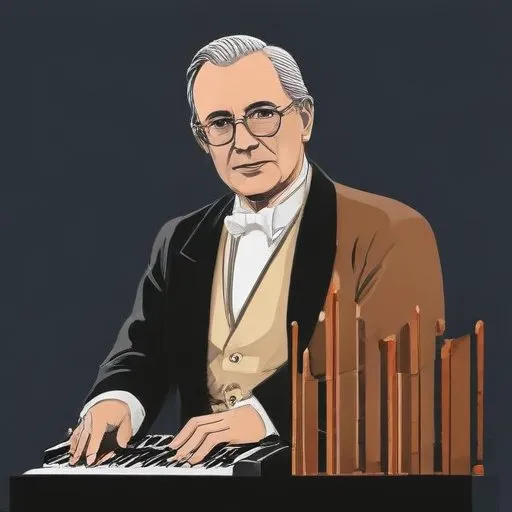
A renowned organist, composer, and educator who made significant contributions to American music, particularly in the field of church music and choral composition.
Horatio William Parker, a renowned American composer, organist, and teacher, left an indelible mark on the musical landscape of New Haven, Connecticut, in the late 19th century. He is best remembered as the undergraduate teacher of Charles Ives, one of the most influential American composers of the 20th century, during Ives' time at Yale University.
Born on September 15, 1863, in Auburndale, Massachusetts, Parker's earliest musical lessons were with his mother. He then studied in Boston with notable musicians George Whitefield Chadwick, Stephen A. Emery, and John Orth. Parker's first professional position was as an organist at St. Paul's Episcopal Church in Dedham, Massachusetts, where he earned a salary of approximately $300 a year from September 1880 to January 1882.
In the 1880s, Parker traveled to Europe, a common destination for young American composers, to further his musical education. He studied in Munich with Josef Rheinberger at the Royal Music School, where his fellow students included Arthur Whiting and H. H. Huss. During this period, Parker composed some of his most significant works, including a symphony and a dramatic cantata. He also premiered Rheinberger's Organ Concerto No. 1 in F Major in 1884.
After returning to the United States in 1885, Parker held various positions as a professor of music and organist at several institutions, including the Cathedral School of St. Paul in Garden City, Long Island, and Trinity Church in New York City and Boston. In 1893, he became the Battell Professor of the theory of music at Yale University, a position he held until his death. He was appointed Dean of Music at Yale in 1904, a position he retained for the rest of his life.
In recognition of his contributions to music, Parker was bestowed with the honorary degree of Doctor of Music (Mus. Doc.) by the University of Cambridge in May 1902. He was also elected as a national honorary member of Phi Mu Alpha Sinfonia fraternity, the national fraternity for men, on December 30, 1915.
Horatio Parker's legacy extends beyond his compositions and teachings. He played a significant role in shaping the musical landscape of New Haven, Connecticut, and left a lasting impact on his students, including Charles Ives. Parker's dedication to his craft and his contributions to the world of music have earned him a place in the annals of American musical history.
Born in 1874
A pioneer of American modernism, this composer blended traditional and experimental elements, creating a unique sound that defied conventions. He's most famous for his symphonies and piano sonatas.
Born in 1860
A renowned pianist and composer, he crafted romantic-era masterpieces that evoke a sense of American folk music, with his most famous work being the "Piano Concerto No. 2".
Born in 1859
A renowned cellist, composer, and conductor, he is most known for his operettas, such as "Babes in Toyland" and "Naughty Marietta", which showcased his mastery of light opera and musical comedy.
Born in 1854
Renowned composer and conductor of patriotic American marches, including "The Stars and Stripes Forever," which evokes feelings of national pride and nostalgia.
Born in 1862
A renowned conductor and composer who led the New York Symphony Orchestra and introduced many Americans to European classical music, also composing operas and orchestral works.
Born in 1854
A prominent composer and educator who contributed significantly to American classical music, particularly in the Romantic era, and founded the New England Conservatory of Music.
Born in 1871
An American composer and academic, known for his romantic and impressionist music, as well as his teaching and administrative roles at prestigious institutions.
Born in 1871
A prominent figure in American classical music, he founded the San Francisco Symphony and composed operas, orchestral works, and chamber music. His contributions helped establish California as a hub for classical music.
