


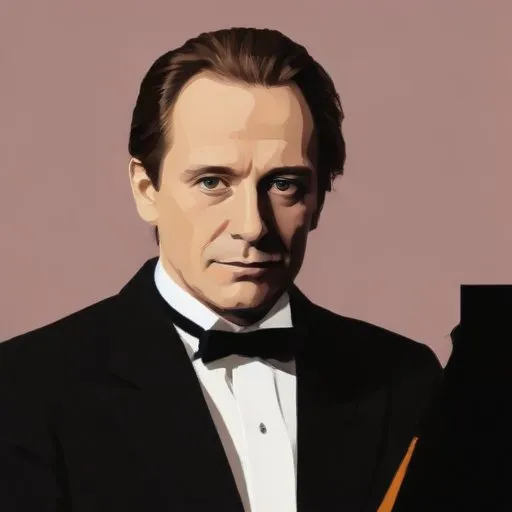
A German-American pianist, composer, and conductor who made significant contributions to the development of American classical music, particularly in the mid-20th century. He's known for his eclectic and innovative style, blending elements of jazz, classical, and folk music.
Ingolf Dahl was a renowned German-born American composer, pianist, conductor, and educator, widely recognized for his diverse musical talents and contributions to the world of classical music.
Born Walter Ingolf Marcus on June 9, 1912, in Hamburg, Germany, Dahl was the son of a German Jewish father, attorney Paul Marcus, and his Swedish wife Hilda Maria Dahl. He had two brothers, Gert Marcus, a noted Swedish artist and sculptor, and Holger, and one sister AnnaBritta.
Dahl's early musical training began in Hamburg, where he studied piano under Edith Weiss-Mann, a harpsichordist, pianist, and proponent of early music. He later continued his studies at the Hochschule für Musik Köln (1930-1932) with Philipp Jarnach.
In 1932, Dahl moved to Zurich, Switzerland, where he studied with Volkmar Andreae and Walter Frey at the University of Zurich. During his six-year stay, he worked at the Zurich Opera, rising from an internship to the rank of assistant conductor. Dahl played a crucial role in the world premieres of Alban Berg's Lulu and Paul Hindemith's Mathis der Maler, serving as a vocal coach and chorus master.
As Switzerland became increasingly hostile towards Jewish refugees, including those of partial Jewish parentage, Dahl emigrated to the United States in 1939. He adopted the name Ingolf Dahl, based on his original middle name and his mother's maiden name, and began a new life in Los Angeles.
Dahl's musical career in the United States was marked by its diversity and depth. He worked as a solo pianist, keyboard performer (piano and harpsichord), accompanist, conductor, coach, composer, and critic. He was part of a vibrant community of expatriate musicians, including Ernst Krenek, Darius Milhaud, Arnold Schoenberg, Igor Stravinsky, and Ernst Toch.
One of Dahl's notable contributions was producing a performing translation of Schoenberg's Pierrot lunaire.
Ingolf Dahl's multifaceted career has left an indelible mark on the world of classical music. His contributions as a composer, pianist, conductor, and educator have inspired generations of musicians and music lovers alike.
Through his work, Dahl bridged the gap between European modernism and American musical culture, enriching the cultural landscape of his adopted country.
Ingolf Dahl's remarkable life and career serve as a testament to the power of music to transcend borders, cultures, and generations. His legacy continues to inspire and delight audiences around the world.
Born in 1882
A Russian master of music, renowned for revolutionizing classical music with bold, avant-garde compositions that blended traditional and modern elements. His iconic works, such as "The Rite of Spring," continue to inspire and influence artists across genres.
Born in 1892
A French composer and educator who blended jazz and classical music to create a unique sound, and is best known for his ballet scores and chamber music compositions.
Born in 1874
A pioneer of atonality and 12-tone serialism, revolutionizing classical music with innovative compositions that pushed boundaries of harmony and melody.
Born in 1897
A child prodigy turned Hollywood legend, he composed iconic film scores, including the swashbuckling adventures of Errol Flynn, and is revered for his lush, romantic music.
Born in 1900
A renowned pianist and composer who blended jazz and classical music to create iconic scores for Broadway and opera, including "The Threepenny Opera" and "Mahagonny".
Born in 1895
A renowned composer, violist, and conductor who blended traditional and modern styles, creating complex yet accessible music that resonated with audiences. His works spanned from operas to chamber music.
Born in 1910
A renowned composer and educator, he was the first president of the Juilliard School and won the Pulitzer Prize for Music in 1943. He's known for his contributions to American classical music.
Born in 1896
A renowned composer, conductor, and educator who made significant contributions to American classical music, particularly through his Romantic-style symphonies and leadership of the Eastman School of Music.
