


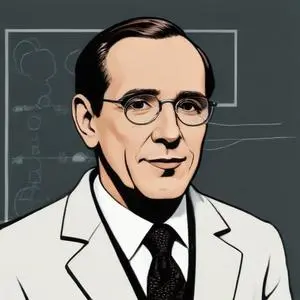
Pioneering computer scientist and psychologist who envisioned and funded the creation of the first operational packet switching network, ARPANET, precursor to the modern internet.
J. C. R. Licklider, a renowned American psychologist and computer scientist, is celebrated for his groundbreaking contributions to the development of modern computing and his pioneering vision of a global computer network, which ultimately led to the creation of the internet.
As one of the first to foresee the potential of interactive computing, Licklider played a pivotal role in shaping the course of computer science, leaving an indelible mark on the industry. His innovative ideas and tireless efforts paved the way for significant advances in computing technology, including the graphical user interface and the ARPANET, the precursor to the internet.
Born on March 11, 1915, in St. Louis, Missouri, Licklider was the only child of Joseph Parron Licklider, a Baptist minister, and Margaret Robnett Licklider. Despite his father's religious background, Licklider did not follow in his footsteps, instead opting for a path in academia.
Licklider's academic pursuits took him to Washington University in St. Louis, where he earned a B.A. with a triple major in physics, mathematics, and psychology in 1937, followed by an M.A. in psychology in 1938. He later received his Ph.D. in psychoacoustics from the University of Rochester in 1942, as well as a Doctorate in Psychology from the same institution.
Licklider's early career saw him working as a research fellow and lecturer in the PsychoAcoustic Laboratory at Harvard University from 1943 to 1950. It was during this period that he developed an interest in information technology, which led him to join MIT in 1950 as an associate professor.
At MIT, Licklider played a crucial role in shaping the institution's computer science program, working closely with other prominent computer scientists of the time. His vision for a global computer network, outlined in his 1963 paper "Resource Sharing Computer Networks," laid the groundwork for the development of the ARPANET, the first operational packet switching network, in the late 1960s.
Licklider's work had a profound impact on modern society, enabling the widespread adoption of computers and the internet in daily life. His contributions to the development of the graphical user interface, which revolutionized human-computer interaction, have had a lasting influence on the way we interact with technology.
Today, the internet, a direct descendant of Licklider's vision, has become an indispensable part of modern life, connecting people across the globe and facilitating rapid communication, information exchange, and e-commerce.
Licklider's contributions to computer science and his vision for a global computer network were recognized with numerous awards and honors, including the National Medal of Science in 1966 and the IEEE John von Neumann Medal in 1969.
In 1990, Licklider was posthumously inducted into the National Inventors Hall of Fame, a testament to his enduring legacy in the field of computer science.
Licklider's approach to computer science was guided by a philosophy that emphasized the importance of collaboration and interdisciplinary research. He believed that the best solutions often emerged from the intersection of seemingly disparate fields.
"The most important thing is to have a goal, and then to get the right people to help you achieve it," Licklider once said, encapsulating his collaborative approach to innovation.
J. C. R. Licklider's pioneering work in computer science and his vision for a global computer network have left an indelible mark on the history of computing. His contributions, characterized by a unique blend of technical expertise and foresight, have had a lasting impact on modern society.
As we navigate the complexities of the digital age, Licklider's legacy serves as a powerful reminder of the importance of innovation, collaboration, and visionary thinking in shaping the future of technology.
87 Years Old
Co-developer of the Transmission Control Protocol, a fundamental communication protocol that enables reliable data transfer over the internet, revolutionizing modern communication. This pioneer's work has had a profound impact on the development of the internet as we know it today.
72 Years Old
Irish guitarist and songwriter, founding member of The Boomtown Rats, known for hits like "I Don't Like Mondays" and "Rat Trap".
83 Years Old
Creator of the Domain Name System (DNS) and Internet Protocol (IP), revolutionizing internet communication and navigation.
Born in 1925
A pioneer in human-computer interaction, he revolutionized personal computing by inventing the mouse, enabling intuitive navigation and transforming the way we interact with technology.
89 Years Old
Developer of the concept of hypertext, which allows users to navigate and link digital information in a non-linear fashion, revolutionizing the way we interact with computers and access knowledge.
98 Years Old
Co-creator of the Logo programming language, which introduced children to coding and revolutionized computer education. Known for his work in artificial intelligence and child-centered learning.
Born in 1912
Pioneering mathematician and computer scientist who cracked the German Enigma code during WWII and laid the foundations for modern computer science and artificial intelligence.
