


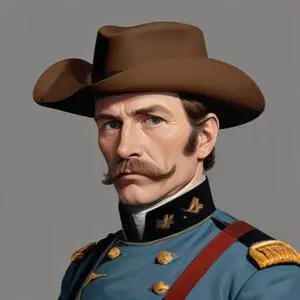
A flamboyant and daring Confederate cavalry commander, known for his bold raids and reconnaissance missions that often outmaneuvered Union forces. He played a key role in several battles, including Gettysburg.
James Ewell Brown "Jeb" Stuart, a Confederate army general and cavalry officer, is renowned for his exceptional mastery of reconnaissance and innovative use of cavalry in support of offensive operations during the American Civil War.
With his flamboyant style, sporting a red-lined gray cape, yellow waist sash, and an ostrich-plumed hat cocked to the side, Stuart cut a dashing figure on the battlefield. However, beneath the glamorous façade lay a shrewd military strategist and a trusted ally of General Robert E. Lee, earning him the sobriquet "the eyes and ears of Lee's army."
Born on February 6, 1833, in Patrick County, Virginia, Stuart graduated from the United States Military Academy at West Point in 1854, ranking 13th out of 46 cadets. He went on to serve in the U.S. Army, participating in frontier conflicts with Native Americans and the violence of Bleeding Kansas. Stuart also played a key role in the capture of John Brown at Harpers Ferry in 1859.
When Virginia seceded from the Union in 1861, Stuart resigned his commission and joined the Confederate Army. He initially served under General Stonewall Jackson in the Shenandoah Valley, before taking command of the cavalry brigade of the Army of Northern Virginia. Stuart's reputation as a daring and innovative cavalry commander grew, particularly during the Peninsula Campaign and the Maryland Campaign, where he circumnavigated the Union Army of the Potomac, bringing fame to himself and embarrassment to the North.
At the Battle of Chancellorsville, Stuart temporarily assumed command of Jackson's infantry corps after the general's injury, further solidifying his reputation as a skilled and adaptable military leader. However, during the Gettysburg Campaign, Stuart's prolonged separation from Lee's army left the general uninformed about Union troop movements, contributing to the Confederate defeat.
Stuart faced criticism from the Southern press and proponents of the Lost Cause movement after the war, who perceived his actions during the Gettysburg Campaign as culpable in the Confederate defeat. Despite this, Stuart remains an iconic figure in American history, celebrated for his bravery, tactical genius, and unwavering dedication to the Confederate cause.
Stuart married Flora Cooke, the daughter of a U.S. Army officer, in 1855, and the couple had two children together. Tragically, Stuart was mortally wounded on May 11, 1864, during the Battle of Yellow Tavern, and he died the following day, at the age of 31.
Though his life was cut short, Stuart's legacy continues to captivate historians and enthusiasts alike, earning him a permanent place among the pantheon of American military heroes.
Born in 1807
Led the Confederate States Army during the American Civil War, surrendering to Union forces at Appomattox, marking the war's effective end.
Born in 1821
A Confederate general during the American Civil War, later serving as a diplomat and ambassador to Turkey, known for his military strategies and post-war reconciliation efforts.
Born in 1825
A Confederate general during the American Civil War, known for his bravery and tactical skills, leading troops in several key battles, including the Battle of Chancellorsville.
Born in 1831
A Confederate general during the American Civil War, known for his bravery and aggressive tactics, but also criticized for his reckless decisions that led to devastating defeats.
Born in 1818
A Confederate general who played a pivotal role in the American Civil War, particularly during the Battle of Fort Sumter, and is often credited with starting the war.
Born in 1817
A Confederate general during the American Civil War, he's infamous for his tactical blunders and defeats, ultimately losing the war for the South.
Born in 1822
Led the Union Army to victory in the Civil War and later became President, known for issuing the Emancipation Proclamation and strengthening federal authority.
