


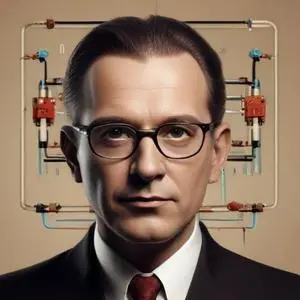
Developed the first general-purpose electronic computer, revolutionizing computing and paving the way for modern technology. Known for pioneering computer architecture and design.
J. Presper Eckert, a pioneer in the field of computing, is renowned for designing the first general-purpose electronic digital computer, ENIAC, and developing the first commercial computer in the United States, UNIVAC. Alongside John Mauchly, Eckert's innovative designs and entrepreneurial spirit revolutionized the computing landscape, transforming the way humans interact with technology.
Born on April 9, 1919, in Philadelphia, Pennsylvania, Eckert was raised in a affluent family with a strong emphasis on education. His mother, Ethel M. Hallowell, descended from an old Philadelphia Quaker family, while his father, John Eckert, was a successful real estate developer of Swiss German and Alsatian descent. Eckert's innate curiosity and passion for electronics led him to attend the William Penn Charter School and later join the Engineers Club of Philadelphia.
In 1943, Eckert and Mauchly collaborated on a top-secret project to develop an electronic computer for the United States Army. The result was ENIAC (Electronic Numerical Integrator and Computer), a behemoth machine that weighed over 27 tons and occupied an entire room. ENIAC's invention marked a significant milestone in computing history, as it could perform calculations at unprecedented speeds and accuracy.
In 1947, Eckert and Mauchly founded the Eckert-Mauchly Computer Corporation, one of the first computer companies in the world. Their pioneering work led to the development of UNIVAC (Universal Automatic Computer), the first commercially available computer in the United States. UNIVAC's innovative design incorporated Eckert's invention of the mercury delay-line memory, a groundbreaking technology that enabled faster and more efficient data processing.
Eckert's contributions to computing have had a profound impact on modern society. His work on ENIAC and UNIVAC paved the way for the development of smaller, faster, and more affordable computers, which have revolutionized the way we live, work, and communicate. Today, computers are an integral part of our daily lives, and Eckert's legacy continues to inspire innovation and progress in the field of computing.
Eckert's life was marked by several personal milestones, including his marriage to Hepsa E. Eckert in 1940 and the birth of their two children, John and Karen. Throughout his life, Eckert was driven by a passion for innovation and a commitment to advancing the field of computing.
J. Presper Eckert's groundbreaking work has left an indelible mark on the field of computing. His innovative designs, entrepreneurial spirit, and commitment to advancing the field have inspired generations of computer scientists, engineers, and innovators. As a pioneer in the field of computing, Eckert's legacy continues to shape the way we interact with technology, and his contributions will be remembered for generations to come.
Born in 1907
Co-founder of the first computer company, credited with developing the ENIAC, the first general-purpose electronic computer, and pioneering the development of modern computers.
Born in 1912
Pioneering mathematician and computer scientist who cracked the German Enigma code during WWII and laid the foundations for modern computer science and artificial intelligence.
Born in 1910
A German computer pioneer who built the world's first fully automatic digital computer, revolutionizing the field of computer science. This innovation paved the way for modern computing as we know it today.
Born in 1890
Developed the concept of the internet's precursor, hypertext, and advocated for government funding of scientific research, shaping modern computing and innovation.
Born in 1916
Developed the mathematical foundations of modern digital communication, creating the basis for modern computing and data transmission.
88 Years Old
Developed Sketchpad, a pioneering computer-aided design (CAD) system, and invented the virtual reality (VR) head-mounted display.
Born in 1925
A pioneer in human-computer interaction, he revolutionized personal computing by inventing the mouse, enabling intuitive navigation and transforming the way we interact with technology.
71 Years Old
Co-founder of Apple and Pixar, revolutionizing personal computers and animation with innovative designs and storytelling. Leaving a lasting impact on the tech and entertainment industries.
