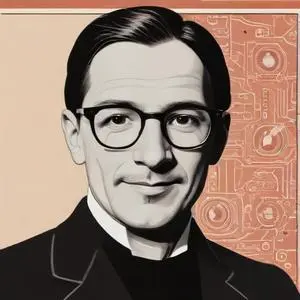
John Mauchly: The Visionary Behind the First General-Purpose Electronic Digital Computer
A Pioneer in Computer Science
John Mauchly is renowned for designing ENIAC, the first general-purpose electronic digital computer, alongside
J. Presper Eckert. This groundbreaking innovation paved the way for the development of modern computers, earning Mauchly a place in the annals of computer science history.
Early Life and Education
Born on August 30, 1907, in Cincinnati, Ohio, to Sebastian and Rachel Scheidemantel Mauchly, John was raised in a family of German descent. His father's work at the Carnegie Institution of Washington led the family to move to
Chevy Chase, Maryland, where John developed an early interest in science, particularly electricity. This curiosity drove him to repair neighbors' electrical systems as a teenager.
Mauchly attended E.V. Brown Elementary School and McKinley Technical High School, where he excelled as debate team member, national honor society inductee, and editor-in-chief of the school newspaper, Tech Life. Upon graduating in 1925, he secured a scholarship to study engineering at
Johns Hopkins University, later transferring to the physics department. Mauchly earned his Ph.D. in physics in 1932, without completing his undergraduate degree.
A Career of Innovation
From 1932 to 1933, Mauchly worked as a research assistant, laying the groundwork for his contributions to computer science. His collaboration with J. Presper Eckert led to the creation of ENIAC (Electronic Numerical Integrator and Computer), the first general-purpose electronic digital computer. This pioneering achievement was followed by the development of EDVAC (Electronic Discrete Variable Automatic Computer), BINAC (Binary Automatic Computer), and UNIVAC I (Universal Automatic Computer), the first commercial computer produced in the United States.
Founding the Eckert-Mauchly Computer Corporation
In 1947, Mauchly and Eckert established the Eckert-Mauchly Computer Corporation (EMCC), the first computer company. This venture enabled them to pioneer fundamental computer concepts, such as the stored program, subroutines, and programming languages.
Influence on Modern Society
The work of Mauchly and Eckert, as detailed in the First Draft of a Report on the EDVAC (1945) and the Moore School Lectures (1946), had a profound impact on computer development worldwide. Their innovations sparked an explosion of computer development in the late 1940s, transforming the landscape of technology.
Legacy and Honors
Mauchly's contributions to computer science have been recognized with numerous awards and honors, including the National Medal of Science (1966) and the IEEE Emanuel R. Piore Award (1973). His legacy continues to inspire generations of computer scientists and engineers.
Philosophical Contributions and Beliefs
Mauchly's work embodies a profound understanding of the potential of technology to shape the future. His innovations were guided by a belief in the importance of collaboration, problem-solving, and the application of scientific principles to real-world challenges.
Personal Milestones and Key Life Events
- 1907: Born in Cincinnati, Ohio
- 1925: Graduated from McKinley Technical High School
- 1932: Earned Ph.D. in physics from Johns Hopkins University
- 1943: Developed ENIAC with J. Presper Eckert
- 1947: Founded the Eckert-Mauchly Computer Corporation with J. Presper Eckert
- 1966: Awarded the National Medal of Science
- 1980: Passed away on January 8
_quotes and Memorable Sayings
_"The best way to predict the future is to invent it."_
John Mauchly's life and work serve as a testament to the power of innovation, collaboration, and vision. His pioneering contributions to computer science continue to shape our world, inspiring future generations to push the boundaries of technological advancement.
FAQ
What was John Mauchlys role in the development of computers?
John Mauchly was an American physicist and co-founder of the first computer company, Remington Rand, and played a key role in the development of the first general-purpose electronic computer, UNIVAC I.
What was John Mauchlys contribution to the field of computer science?
John Mauchlys contribution to the field of computer science was his development of the Short Code, a programming language that facilitated the use of computers for business applications, and his work on the design of the BINAC computer.
How did John Mauchlys work influence the development of modern computers?
John Mauchlys work influenced the development of modern computers by laying the foundation for the development of commercial computers, paving the way for the widespread adoption of computers in business and industry.
What was John Mauchlys relationship with J. Presper Eckert?
John Mauchly and J. Presper Eckert were collaborators and friends who worked together on the development of the ENIAC and UNIVAC I computers, and founded the Remington Rand computer company together.
What is John Mauchlys legacy in computer science?
John Mauchlys legacy in computer science is that of a pioneer who helped to shape the development of modern computers, and whose work laid the foundation for the creation of the computer industry as we know it today.