


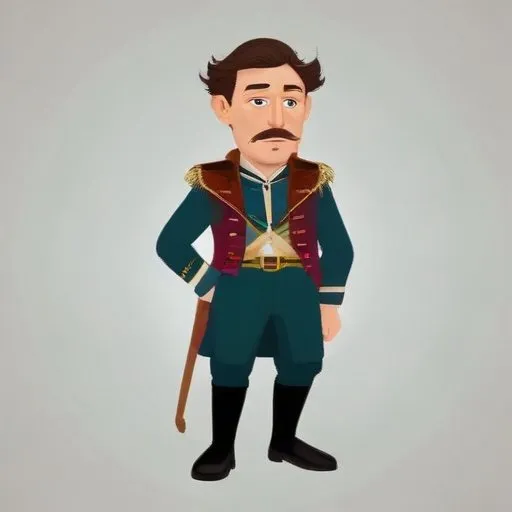
A 19th-century sailor, hunter, and explorer who led expeditions to the Antarctic, discovering new islands and charting previously unknown territories. He pushed the boundaries of human exploration in the frozen continent.
James Weddell is renowned for being the first sailor to venture into the Weddell Sea, a region of the Southern Ocean that lies south of the Antarctic Circle. On February 20, 1823, he reached a latitude of 74°15'S, a record-breaking feat that would remain unchallenged for over 80 years.
Born on August 24, 1787, in Ostend, Belgium, Weddell was the son of a Scottish sea captain. Growing up on the high seas, he received little formal education, but taught himself to read and write. At the tender age of eight, he was apprenticed as a seaman, working on merchant ships along the northeast Scottish coast.
Weddell's early years were marked by adventure and turmoil. In 1808, he was handed over to the Royal Navy for punishment after striking his captain, a serious offense. However, this incident proved to be a blessing in disguise. During his imprisonment, Weddell studied navigation, and upon his release, he joined the Royal Navy as a midshipman. He quickly rose through the ranks, becoming a captain and serving on various ships, including the HMS Hope.
In 1819, Weddell was introduced to James Strachan, a shipbuilder from North Leith, who owned the 160-ton brig Jane. Strachan, along with James Mitchell, an Scottish insurance broker, refitted the ship for sealing expeditions. News of the discovery of the South Shetland Islands had just broken, and Weddell saw an opportunity to explore the uncharted waters of the Antarctic.
On September 17, 1822, Weddell set sail on the Jane, embarking on a journey that would take him to the farthest reaches of the Southern Ocean. After navigating through treacherous icebergs and dense fog, Weddell reached the Weddell Sea on February 20, 1823. He spent several weeks exploring the region, charting new lands, and discovering unknown species.
Weddell's exploit opened up the Antarctic to further exploration, paving the way for future expeditions. His discovery of the Weddell Sea and the surrounding islands expanded our understanding of the region's geography and ecosystems. Today, the Weddell Sea remains an important site for scientific research, with scientists continuing to study its unique and fragile environment.
Little is known about Weddell's personal life, but it is believed that he returned to a quiet life in Britain after his Antarctic expedition. He died on September 9, 1834, leaving behind a legacy as one of the greatest sailors and explorers of his time.
Weddell's achievements were recognized by the Royal Geographical Society, which awarded him the Gold Medal in 1823.
Born in 1868
Led a British expedition to the South Pole, racing against a Norwegian team, and tragically perished on the return journey. He is remembered for his bravery and sacrifice in the pursuit of scientific discovery.
Born in 1874
Led expeditions to the Antarctic, famously surviving a disastrous shipwreck and trekking to safety, earning a legendary reputation for bravery and leadership.
Born in 1872
First person to reach the South Pole, leading a Norwegian expedition in 1911, and a pioneer in Arctic and Antarctic exploration.
Born in 1800
Led British expeditions to the Arctic, discovering the North Magnetic Pole and the Ross Sea in Antarctica. He mapped much of the region, expanding knowledge of the polar regions.
Born in 1778
Russian admiral, cartographer, and explorer who led the first expedition to sight Antarctica in 1820, charting its coastline and contributing significantly to the continent's discovery.
Born in 1790
A French naval officer who led expeditions to the Pacific and Antarctica, discovering new lands and mapping uncharted territories. He's credited with discovering the Venus de Milo statue.
Born in 1867
A French physician and explorer who led several expeditions to the Antarctic and Arctic regions, making significant contributions to the field of geography and cartography.
Born in 1681
Led a series of expeditions that mapped much of the Arctic coast of Siberia and discovered several islands, including the Bering Islands. He also led the first European expedition to sight mainland Alaska.
