


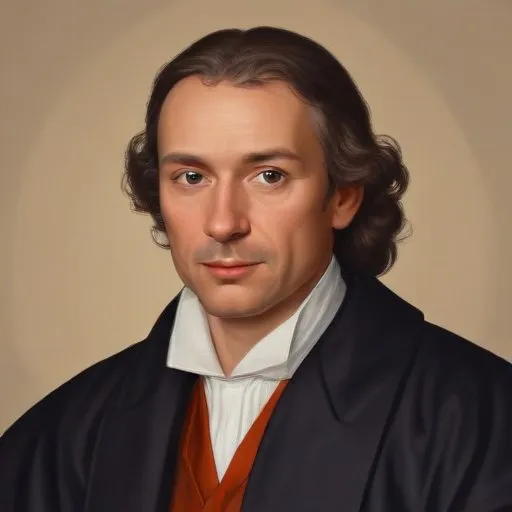

The Father of Gas Chemistry
Jan Baptist van Helmont, a 17th-century chemist, physiologist, and physician, is renowned for his groundbreaking work in the field of pneumatic chemistry. He is credited with introducing the term "gas" into the scientific vocabulary, derived from the Greek word "chaos," and his pioneering experiment on the growth of a willow tree, which laid the foundation for modern chemistry.
Early Life and Education
Born on January 12, 1580, in Brussels, van Helmont was the youngest of five children to Maria van Stassaert and Christiaen van Helmont, a public prosecutor, and council member. He received his education at Leuven, where he studied various sciences before eventually focusing on medicine. During his studies, he took a break to travel through Switzerland, Italy, France, Germany, and England, exposing himself to diverse scientific perspectives.
Medical Career and Practice
Van Helmont obtained his medical degree in 1599 and began practicing in Antwerp. During the great plague of 1605, he wrote a book titled De Peste (On Plague), which was later reviewed by Sir Isaac Newton in 1667. He received his doctoral degree in medicine in 1609 and eventually retired from his medical practice to focus on chemical experiments.
Scientific Contributions and Ideas
Van Helmont's work was influenced by the mystic and alchemist Paracelsus, although he rejected some of his ideas. He is known for his concept of "seminal virtues," which posited that each element has a unique essence or virtue that defines its properties. This idea paved the way for modern chemistry's understanding of elements and compounds.
The Willow Tree Experiment
One of van Helmont's most notable experiments involved measuring the growth of a willow tree over five years. He observed that the tree gained weight despite being watered only with rainwater, concluding that water was not the sole source of the tree's growth. This experiment challenged the prevailing Aristotelian view that plants obtain their nourishment from water alone.
Legacy and Impact
Van Helmont's work had a significant impact on the development of modern chemistry. His concept of "gas" helped to establish the field of pneumatic chemistry, and his willow tree experiment laid the foundation for modern plant physiology. He is considered one of the founders of modern chemistry, alongside figures like Antoine Lavoisier and Joseph Priestley.
Personal Life and Family
Van Helmont married Margaret van Ranst, a member of a wealthy noble family, in 1609. They had six or seven children and lived in Vilvoorde, near Brussels. Margaret's inheritance enabled van Helmont to retire early from his medical practice and focus on his chemical experiments.
Quotes and Memorable Sayings
"The art of chemie is not a speculation, but an experimental art, and it doth not consist in talking, but in doing."
Fun Facts and Trivia
- Van Helmont's name has multiple renderings, including Jan Baptiste, Johannes Baptista, Johann Baptista, and Joan Baptista.
- He was a prolific writer and published several books on chemistry, medicine, and alchemy.
Historical Context and Legacy
Jan Baptist van Helmont lived during a period of significant scientific transformation, bridging the gap between the alchemical traditions of Paracelsus and the rise of modern chemistry. His work laid the foundation for later scientists to build upon, cementing his place as one of the most important figures in the history of chemistry.