


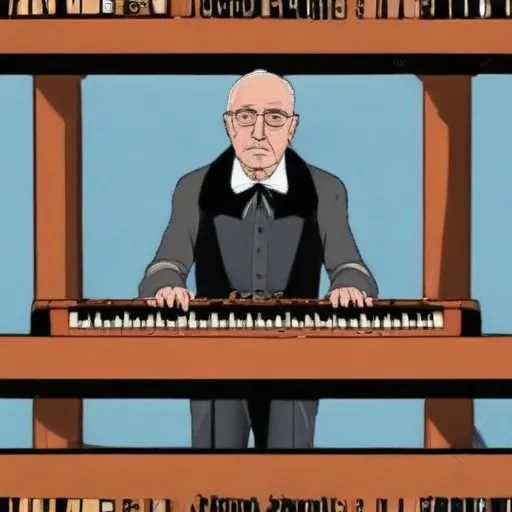
Czech organist, composer, and educator renowned for his Baroque-era compositions and influential music pedagogy. His works include sacred music, orchestral suites, and chamber pieces.
Renowned as a Czech organist, mandolinist, harpsichordist, music composer, operatic conductor, and teacher, Jan Ktitel Kucha left an indelible mark on the world of music. His diverse talents and contributions to the field of music are a testament to his extraordinary skill and passion.
Born on March 5, 1751, in Chote, Kucha's parents moved to Mlzávoje soon after, where he spent his childhood. He received his early music education in Vrchlab with the organist Alex Thm and later studied at the Jesuit seminary in Hradec Králové and Jín. It was in Prague that he honed his skills under the guidance of the esteemed organist Josef Seger.
In 1772, Kucha became the organist at the Church of St. Henry in Prague, a position that marked the beginning of his illustrious career. He soon ventured into teaching music to the noble families of Hartig, Bucquoy, and Pchovský, imparting his knowledge of singing, piano, organ, and composition.
Kucha was among the first to recognize the genius of Wolfgang Amadeus Mozart, and he played a significant role in propagating the composer's work. In 1786, he likely performed at the premiere of The Marriage of Figaro at the Stavovské divadlo. The following year, he met Mozart during the latter's visit to Prague and even accompanied him on the harpsichord at the premiere of Don Giovanni.
Kucha's admiration for Mozart's work led him to create piano excerpts from the operas The Marriage of Figaro, Cos fan tutte, and even wrote recitatives for an Italian version of The Magic Flute.
In 1790, Kucha left the Church of St. Henry to become the organist of the Strahov Monastery, where he played at the Church of the Assumption of the Virgin Mary. This new role allowed him to continue teaching mandolin, organ, and music theory, as well as perform standalone concerts that further solidified his reputation.
In 1791, Kucha's talents were recognized, and he was appointed conductor of the Prague opera, a position he held for many years. During this period, his own compositions met with success, and his association with Mozart continued to flourish.
Kucha's multifaceted career left an indelible mark on the world of music. As a teacher, he nurtured the talents of many, while his compositions and performances showcased his mastery of various instruments and genres. His recognition and propagation of Mozart's work contributed significantly to the latter's posthumous fame.
Today, Jan Ktitel Kucha is remembered as a true stalwart of the music world, whose diverse talents and contributions continue to inspire generations of musicians and music enthusiasts.
Born in 1824
A Czech pianist and composer who is often referred to as the father of Czech national music, known for his operas and symphonic poems that evoke a strong sense of national identity.
Born in 1841
A Czech composer and academic who blended folk influences with classical music, creating iconic works like the "New World Symphony".
Born in 1874
A Czech virtuoso violinist and composer, known for his romantic and expressive works, including his iconic Asrael Symphony, which showcases his mastery of orchestration and emotional depth.
Born in 1870
A Czech composer and educator who blended folk elements with modernist techniques, creating a unique national style in his orchestral and chamber works.
Born in 1850
A Czech Romantic-era composer and poet, known for his operas and symphonic poems that showcased his country's folklore and literature. His music is still widely performed in the Czech Republic today.
Born in 1854
A Czech composer and theorist who created innovative, folk-inspired operas and orchestral works that explored the human experience, often with a focus on social justice and morality.
Born in 1890
A Czech-American pianist and composer who blended neoclassicism and surrealism, creating innovative works that merged classical music with jazz and avant-garde elements.
