


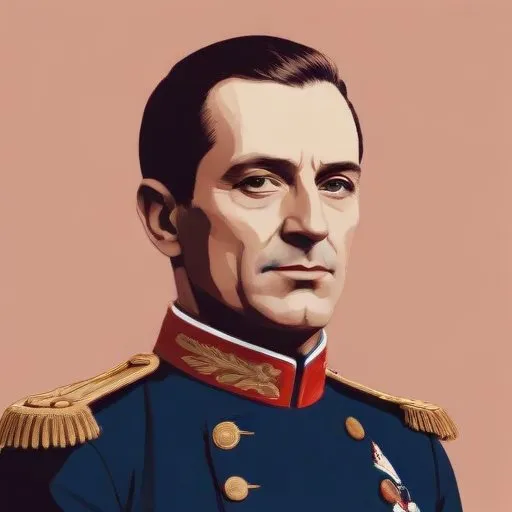
A French Revolutionary Wars general who led armies to several victories, but was later accused of treason and died under mysterious circumstances.
Jean-Charles Pichegru, a renowned French general, holds a significant place in the annals of history for his instrumental role in shaping the country's fate during the Revolutionary Wars. Under his command, French troops overran Belgium and the Netherlands, and he fought valiantly on the Rhine front, leaving an indelible mark on the military landscape.
Born on February 16, 1761, in a peasant family in Arbois, France, Pichegru was initially educated by friars before attending the military school of Brienne-le-Château. It was here that he taught mathematics to none other than a young Napoleon Bonaparte, who would later become a prominent figure in French history.
In 1783, Pichegru joined the 1st regiment of artillery and swiftly rose through the ranks, becoming adjutant-second lieutenant. He briefly served in the American Revolutionary War, which laid the foundation for his future military endeavors.
When the French Revolution erupted in 1789, Pichegru became the leader of the Jacobin Club in Besançon. He was elected lieutenant colonel when a regiment of volunteers from the department of the Gard marched through the city. His exceptional organizational skills and leadership abilities caught the attention of the French Revolutionary Army, and he was appointed to the headquarters, eventually earning the promotion to général de brigade in 1793.
Lazare Carnot and Louis de Saint-Just, instrumental figures in the Revolution, recognized Pichegru's potential and appointed him to lead the French troops on the Rhine front. Under his command, the French army achieved significant victories, earning him a reputation as a skilled and fearless military strategist.
However, Pichegru's royalist leanings led to his downfall. Following the Coup of 18 Fructidor in 1797, he was imprisoned in Cayenne, French Guiana. After escaping into exile in London, he joined the staff of Alexander Korsakov and began plotting the Pichegru Conspiracy to remove Napoleon from power. The plan ultimately failed, leading to his arrest and tragic death in 1804.
Despite his tumultuous career and ultimate demise, Pichegru's surname is etched under the Arc de Triomphe, a testament to his significant contributions to French history. His military prowess and strategic mind left an indelible mark on the French Revolutionary Wars, shaping the country's fate and leaving a lasting legacy.
In conclusion, Jean-Charles Pichegru's remarkable life, marked by both triumph and tragedy, serves as a testament to his unwavering dedication to his country and his unrelenting pursuit of military excellence. His legacy continues to inspire and fascinate, offering a glimpse into the tumultuous era of the French Revolution.
Born in 1769
A French military leader who rose to prominence during the French Revolution and became Emperor of France, known for his military conquests and reorganization of Europe. He is also famous for his Napoleonic Code, which remains a foundation of modern law.
Born in 1755
A key figure in the French Revolution, leading the coup that overthrew Maximilien Robespierre and later serving as a key advisor to Napoleon Bonaparte. He played a crucial role in shaping French politics during a tumultuous period.
Born in 1763
A skilled military strategist who played a key role in the French Revolutionary Wars, earning recognition for his victories against Austrian and Russian forces.
Born in 1757
French Revolutionary and Napoleonic Wars general who played a key role in several battles, earning him a Marshal of France title. He's also known for his bravery and tactical genius.
Born in 1758
A skilled military strategist and one of Napoleon's most trusted generals, known for his victories in the Peninsular War and his role in shaping modern warfare.
Born in 1769
A skilled military strategist and one of Napoleon's most trusted generals, known for his bravery and tactical genius on the battlefield.
Born in 1767
A flamboyant and daring cavalry commander who played a key role in Napoleon's military conquests, earning the title of King of Naples.
Born in 1770
A renowned military strategist and statesman who played a crucial role in Napoleon's conquests and later became a key figure in French politics, known for his exceptional organizational skills and bravery.
