


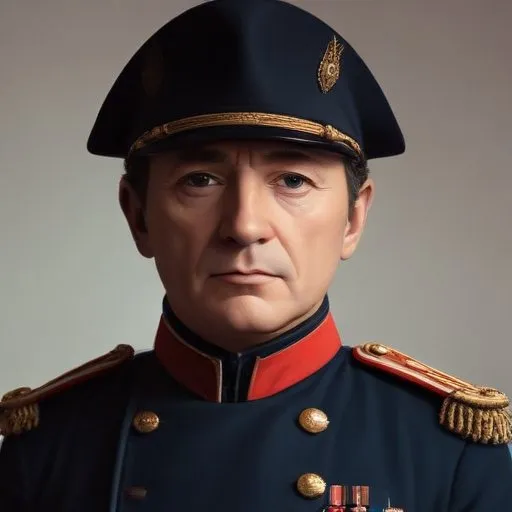
A skilled military strategist who played a key role in the French Revolutionary Wars, earning recognition for his victories against Austrian and Russian forces.
Jean Victor Marie Moreau was a French general who played a crucial role in shaping the course of European history during the late 18th and early 19th centuries. He is perhaps best known for his military prowess, which earned him recognition as one of the foremost French generals in military history, and for his complex and tumultuous relationship with Napoleon Bonaparte, the future Emperor of France.
Born on February 14, 1763, in Morlaix, Brittany, Moreau was the son of a successful lawyer who had other plans for his son's future. Instead of following in his father's footsteps, Moreau was drawn to the military, and in 1791, he was elected lieutenant colonel of the volunteers of Ille-et-Vilaine.
Moreau's leadership skills and martial character quickly propelled him through the ranks. He served under Charles François Dumouriez and in 1793, his brigade's good order and his own republican principles earned him a promotion to général de brigade.
The Battle of Tourcoing in 1794 cemented Moreau's military fame, and in 1795, he was given command of the Army of the Rhine and Moselle. He led his troops to several victories, penetrating deep into Germany and earning a reputation as a skilled military strategist.
One of Moreau's most notable achievements was his retreat from Germany, which was considered a model for such operations. He managed to bring back a substantial portion of his army, enhancing his reputation and solidifying his position as a respected military leader.
Moreau's rivalry with Napoleon Bonaparte began when they were both rising stars in the French military. Moreau's successes on the battlefield and his growing popularity threatened Napoleon's own ambition, leading to a series of power struggles between the two men.
In 1804, Moreau was accused of plotting against Napoleon and was eventually banished to the United States, where he lived in exile until his death in 1813.
Despite his tumultuous relationship with Napoleon, Moreau's military contributions and legacy continue to be celebrated. He is remembered as one of the greatest French generals in history, and his campaigns and battles are still studied by military strategists today.
Moreau's impact on modern society extends beyond the military realm. His influence can be seen in the many generals and leaders who followed in his footsteps, and his story serves as a testament to the complexities and intrigue of European politics during the late 18th and early 19th centuries.
Moreau's military campaigns and strategies continue to be studied and admired by military historians and strategists today.
His legacy can be seen in the many generals and leaders who followed in his footsteps, including Napoleon himself, who often sought to emulate Moreau's military prowess.
"A general must be able to think on his feet and adapt to changing circumstances."
This quote, attributed to Moreau, highlights his emphasis on flexibility and quick thinking in military strategy.
Moreau's contributions to French military history are still celebrated today. He is remembered as one of the greatest generals in French history, and his name is etched in the Arc de Triomphe in Paris.
Despite his complex and often tumultuous relationship with Napoleon, Moreau's legacy serves as a testament to his military prowess and his enduring impact on European history.
Born in 1769
A French military leader who rose to prominence during the French Revolution and became Emperor of France, known for his military conquests and reorganization of Europe. He is also famous for his Napoleonic Code, which remains a foundation of modern law.
Born in 1770
A renowned military strategist and statesman who played a crucial role in Napoleon's conquests and later became a key figure in French politics, known for his exceptional organizational skills and bravery.
Born in 1758
A skilled military strategist and one of Napoleon's most trusted generals, known for his victories in the Peninsular War and his role in shaping modern warfare.
Born in 1767
A flamboyant and daring cavalry commander who played a key role in Napoleon's military conquests, earning the title of King of Naples.
Born in 1753
A French general, mathematician, and politician who played a crucial role in the French Revolution and is considered the "Organizer of Victory" for his military strategies, and also made significant contributions to mathematics and engineering.
Born in 1763
French admiral who commanded the combined French and Spanish fleet during the Napoleonic Wars, ultimately defeated at the Battle of Trafalgar in 1805.
Born in 1753
A skilled military strategist and Napoleon's chief of staff, he played a crucial role in many French military victories and was later appointed Minister of Defence. He's known for his exceptional organizational skills and ability to coordinate large-scale military operations.
