


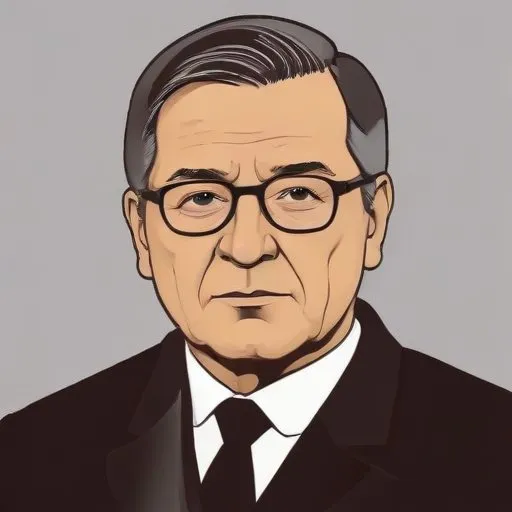
A Belgian lawyer and politician who served as the 2nd President of the European Commission, playing a key role in shaping the European Union's early development and integration. He's known for his efforts to create a single European market and promote economic cooperation among member states.
Jean Rey, a Belgian politician and statesman, is best known for his tireless efforts to promote European integration and federalism. As the second president of the European Commission from 1967 to 1970, he played a pivotal role in shaping the European Economic Community (EEC) and laying the foundations for the modern European Union.
Born on July 15, 1902, in Liège, Belgium, Rey came from a Protestant family. He studied law at the University of Liège, earning a PhD in 1926. Rey began his career as a barrister at the Court of Appeal in Liège, but his commitment to the Walloon Movement soon drew him into politics.
In 1935, Rey was elected city councillor of Liège, and in 1939, he won a seat in the Belgian Chamber of Representatives. During World War II, he was one of the most vocal opponents of Belgium's policy of independence and neutrality. He was mobilized as a reserve officer in 1940 and served during the Battle of Belgium, eventually becoming a prisoner of war. This experience would later shape his views on European integration and federalism.
After the war, Rey became a passionate advocate for the federalization of Belgium. In 1947, he promoted a bill on the organization of a federal state, which would have transformed Belgium into a confederation consisting of two states, Flanders and Wallonia, and the federal region of Brussels. Although the proposal was rejected, Rey continued to push for greater European integration.
In 1958, Rey became the European Commissioner for External Relations, a position he held until 1967. During this period, he played a crucial role in the development of the European Coal and Steel Community and the negotiations that led to the creation of the EEC. In 1967, he was appointed the second president of the European Commission, a position he held until 1970.
Jean Rey's contributions to European integration and federalism are undeniable. He was a true champion of European unity, and his work laid the foundation for the modern European Union. The College of Europe named the 1983-1984 academic year in his honor, a testament to his enduring legacy.
Jean Rey's life and work serve as a testament to the power of dedication and perseverance in shaping the course of history. His legacy continues to inspire generations of European leaders and citizens alike, reminding us of the importance of unity, cooperation, and federalism in building a stronger, more united Europe.
Born in 1901
First President of the European Commission, instrumental in shaping the EU's early development and integration, and a key figure in post-war European politics.
Born in 1908
A Dutch farmer-turned-politician who played a crucial role in shaping the European Union's agricultural policy and served as the President of the European Commission from 1972 to 1973. He's credited with modernizing European agriculture and promoting a united Europe.
Born in 1877
First President of the Italian Republic, instrumental in shaping the country's post-WWII government and constitution. Known for his key role in Italy's transition to a republic.
Born in 1907
A key architect of the European Union, he drafted the Ventotene Manifesto, a foundational document for European integration. His work laid the groundwork for a unified Europe.
Born in 1899
A Belgian lawyer and politician who served as the 46th Prime Minister of Belgium, known for his key role in shaping the European Union and its institutions. He was a strong advocate for European integration and cooperation.
Born in 1876
Led post-war West Germany's reconstruction and served as a key figure in shaping the country's modern identity, earning him the title "Father of the Federal Republic."
Born in 1810
A renowned Romantic-era composer and influential music critic, known for his expressive and emotionally charged works, including symphonies, piano music, and art songs.
