


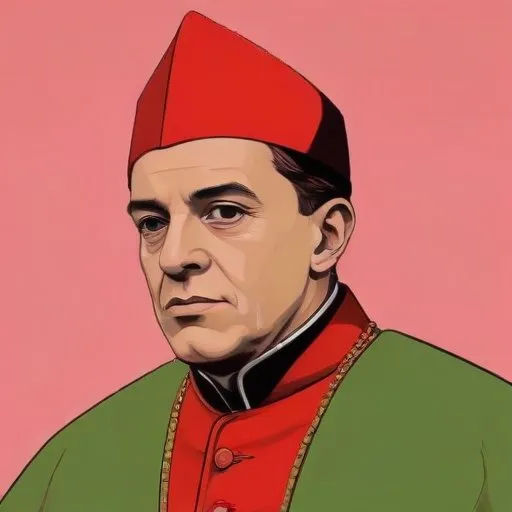
First Latin American cardinal, known for advocating for the Catholic Church's role in Brazilian politics and society. He played a key role in shaping the country's religious landscape.
Joaquim Arcoverde de Albuquerque Cavalcanti is revered as the first cardinal born in Latin America, a title bestowed upon him in 1905 by Pope Pius X. As the Archbishop of Rio de Janeiro from 1897 to 1930, he left an indelible mark on the Catholic Church in Brazil and beyond.
Born on January 17, 1850, in Cimbres, province of Pernambuco, Brazil, Arcoverde hailed from a prominent family. His early vocation for the priesthood led him to pursue studies in Rome, where he was ordained in 1874. Upon his return to Olinda, he became the rector of the new seminary, laying the foundation for his eventual rise through the Church's ranks.
In 1888, Pope Leo XIII nominated Arcoverde as a bishop, but he declined the offer. Undeterred, the Pope nominated him again three years later to the diocese of Goiás, which Arcoverde accepted willingly. This marked the beginning of his ascension to the highest echelons of the Church.
In 1897, Arcoverde was promoted to the archiepiscopal see of São Sebastião do Rio de Janeiro, the highest position in the Latin American Church. This appointment solidified his reputation as a prominent figure in the Catholic Church.
On December 11, 1905, Pope Pius X made Arcoverde a cardinal, a historic moment that marked the first time a Latin American-born prelate had received this honor. He was only the second cardinal to serve as ordinary of a diocese in the Southern Hemisphere, following in the footsteps of Francis Patrick Moran, the Irish-born Archbishop of Sydney.
Arcoverde participated in the conclave of 1914 but did not attend the 1922 conclave due to ill health. Despite his physical limitations, he remained committed to his duties as Archbishop of Rio de Janeiro.
Arcoverde led the See of Rio de Janeiro for over 30 years, until his passing on April 18, 1930. His remarkable tenure was marked by dedication, perseverance, and a deep commitment to the Catholic Church. In his later years, from 1921 onwards, he was aided by a coadjutor archbishop due to failing health.
Arcoverde's pioneering spirit and unwavering devotion to the Church have inspired generations of Catholics in Brazil and beyond. His legacy continues to shape the Catholic Church in Latin America, serving as a testament to his enduring impact on modern society.
Throughout his life, Arcoverde remained steadfast in his commitment to the principles of the Catholic Church. His philosophical contributions centered around upholding the values of faith, compassion, and service to others. His beliefs were rooted in a deep understanding of Catholic doctrine and a passion for spreading the Gospel.
Arcoverde's remarkable life and achievements were recognized with numerous awards and honors. His elevation to the College of Cardinals in 1905 remains one of the highest accolades bestowed upon him.
Joaquim Arcoverde de Albuquerque Cavalcanti's extraordinary life serves as a beacon of inspiration for Catholics worldwide. As the first cardinal born in Latin America, he paved the way for future generations of Church leaders, leaving an indelible mark on the Catholic Church and Brazilian society.
Born in 1504
Leader of the Catholic Church during the Counter-Reformation, he excommunicated Queen Elizabeth I and played a key role in the Council of Trent.
Born in 1675
A 18th-century pope who reformed the Catholic Church, promoting tolerance and scholarship, and is known for his encyclicals on topics like usury and the sacraments.
Born in 1876
The leader of the Catholic Church from 1939 to 1958, known for his controversial role during World War II, particularly in regards to the Holocaust. He is also remembered for his encyclicals on social justice and liturgical reforms.
Born in 1876
The leader of the Catholic Church from 1939 to 1958, known for his controversial role during World War II, particularly in regards to the Holocaust. He is also remembered for his encyclicals on social justice and liturgical reforms.
Born in 1920
A Brazilian cardinal who played a key role in the country's Catholic Church, advocating for social justice and human rights, particularly for the poor and marginalized.
Born in 1924
Brazilian Catholic Church leader who served as the Archbishop of Fortaleza and was a key figure in the Catholic Church's progressive wing, advocating for social justice and human rights.
