


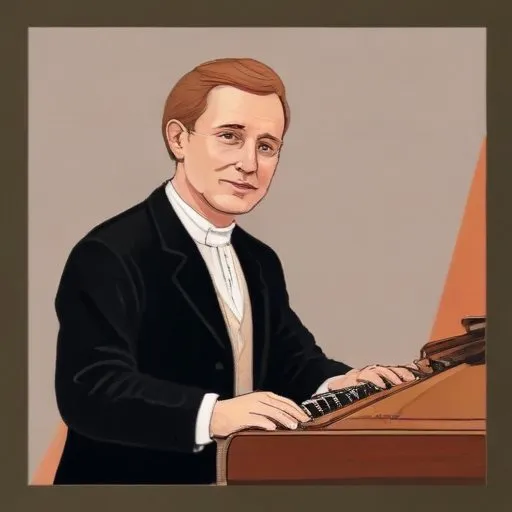
A renowned Dutch organist and composer, he created numerous works for organ, choir, and orchestra, earning him recognition in the classical music world. His compositions showcased exceptional craftsmanship and beauty.
Johan Wagenaar was a Dutch composer and organist, renowned for his exceptional talent in music and his impact on the musical world. He was a prolific composer, creating a wide range of works, including operas, cantatas, organ music, and orchestral pieces, that showcased his mastery of various genres.
Wagenaar was born on November 1, 1862, in Utrecht, Netherlands, to Cypriaan Gerard Berger van Hengst and Johanna Wagenaar. His parents, from different social backgrounds, never married, and Wagenaar took his mother's name as his family name. Despite this, he received support and encouragement from his father, who recognized his talent and nurtured his love for music.
Wagenaar began his musical education at the age of 13, studying piano, organ, violin, theory, and composition under the guidance of Richard Hol and Samuel de Lange, Jr. He later continued his studies with Heinrich von Herzogenberg in Berlin, where he honed his skills in counterpoint.
Wagenaar's career took off in 1888 when he succeeded Richard Hol as organist of Utrecht Cathedral. His exceptional skills on the organ earned him widespread recognition, and he became a celebrated figure in the musical world.
In 1896, Wagenaar became a teacher at the music school in Utrecht and later became its director in 1904. He also held a position with the Utrecht Municipal Orchestra, further solidifying his reputation as a talented musician.
From 1919 to 1937, Wagenaar served as the director of the Royal Conservatory at The Hague, where he taught and mentored many students, including notable composers such as Peter van Anrooy, Emile Enthoven, and Leon Orthel.
Wagenaar's compositions were heavily influenced by the works of Hector Berlioz and Richard Strauss. His music is characterized by its rich harmonies, complex structures, and innovative use of orchestration.
His operas, cantatas, and choral works showcased his mastery of vocal writing, while his organ music and orchestral pieces demonstrated his technical skill and creativity.
Wagenaar married Dina Petronella van Valkenburg in 1897, and they had two daughters together. He passed away on June 17, 1941, in Den Haag, leaving behind a legacy of exceptional music and a lasting impact on the world of classical music.
Today, Wagenaar's compositions continue to be performed and admired by audiences around the world. His contributions to Dutch music and his influence on subsequent generations of composers have cemented his place as one of the most important figures in Dutch musical history.
Wagenaar's music continues to inspire and delight audiences, and his legacy as one of the most important Dutch composers of his time remains unchallenged.
Born in 1864
A renowned composer and conductor of the late Romantic era, known for his tone poems and operas that showcased his mastery of orchestration and expressive storytelling.
Born in 1860
A visionary composer and conductor who expanded symphonic music's emotional depth and complexity, creating works of profound beauty and intensity.
Born in 1860
A Slovene-Austrian composer who expanded the art of songwriting by setting poetic lyrics to music, creating a new level of emotional intensity and depth. His innovative compositions continue to influence classical music today.
Born in 1813
A revolutionary composer who transformed opera with his epic, mythological works, creating a new era of musical storytelling. His iconic operas, such as "Der Ring des Nibelungen," continue to captivate audiences worldwide.
Born in 1863
A renowned pianist, composer, and conductor, known for his interpretations of Beethoven and Brahms, as well as his own symphonic works.
Born in 1864
A renowned pianist and composer who bridged the Romantic and early 20th-century styles, known for his expressive performances and operas like "Tiefland".
