


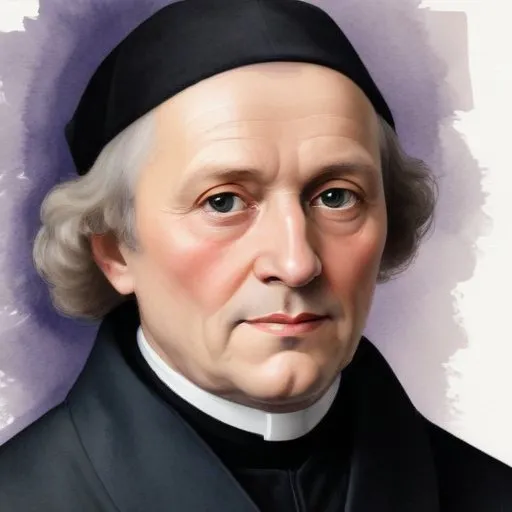
A German-Lutheran clergyman and scholar who pioneered biblical criticism and developed a systematic approach to understanding the New Testament, producing a critical edition of the Greek text. His work laid the foundation for modern biblical scholarship.
Johann Albrecht Bengel, also known as Bengelius, is renowned for his groundbreaking edition of the Greek New Testament and his comprehensive commentaries on it. His work has had a lasting impact on biblical scholarship, making him one of the most influential theologians of the 18th century.
Bengel was born on June 24, 1687, in Winnenden, Württemberg, Germany. After his father's death in 1693, he was educated by David Wendel Spindler, a family friend who later became a master in the gymnasium at Stuttgart. Bengel's early education laid the foundation for his future academic pursuits.
In 1703, Bengel entered the University of Tübingen, where he delved into the works of Aristotle and Spinoza, and theologically, into those of Philipp Spener, Johann Arndt, and August Francke. His knowledge of Spinoza's metaphysics was exceptional, earning him recognition from one of his professors, who tasked him with preparing materials for a treatise, De Spinosismo, which was later published.
Bengel was ordained in 1707 and appointed to the parochial charge of MetzingenunterUrach. The following year, he returned to Tübingen as a theological tutor (Repetent). He remained at Tübingen until 1713, when he was appointed head of a seminary at Denkendorf, a preparatory school of theology.
Before assuming his new duties, Bengel embarked on a tour of Germany, studying various educational systems and visiting the seminaries of the Jesuits, Lutherans, and Reformed churches. His travels took him to Heidelberg, where he acquainted himself with Gerhard von Maastricht's canons of scripture criticism, and to Halle, where he studied Campeius Vitringa's works.
Bengel's philosophical contributions revolved around his studies on Spinoza's metaphysics and Aristotle's works. His theological beliefs were shaped by the pietist movement, which emphasized personal devotion, spiritual rebirth, and a more introspective approach to Christianity.
Bengel's magnum opus, Gnomon Novi Testamenti, a comprehensive commentary on the Greek New Testament, remains an indispensable resource for biblical scholars. His work has influenced generations of theologians and continues to be a testament to his dedication to biblical scholarship.
Johann Albrecht Bengel's life and work embody the essence of a committed scholar and devoted theologian. His contributions to biblical studies have left an indelible mark on the world of theology, ensuring his legacy as a prominent figure in Christian scholarship.
Born in 1483
A German monk and priest who sparked the Protestant Reformation, challenging Catholic Church authority and shaping Western Christianity. He's famous for nailing 95 theses to a church door, sparking a religious revolution.
Born in 1509
A French pastor and theologian who played a key role in the Protestant Reformation, shaping Christian theology and influencing Western civilization. He's famous for his teachings on predestination and his role in establishing Calvinism.
Born in 1484
Leader of the Swiss Reformation, advocating for church reform and inspiring other Protestant movements.
Born in 1497
A 16th-century Renaissance scholar who made significant contributions to the development of the Protestant Reformation and education, known for his theological writings and astronomical observations.
Born in 1703
A prominent figure in the 18th-century Methodist movement, he founded the Methodist Church and emphasized personal faith, social justice, and education. His teachings and legacy continue to shape Protestantism today.
Born in 1834
A renowned Baptist preacher and prolific writer, known for his powerful sermons and numerous published works that still inspire and influence Christians today.
Born in 1906
A German pastor and theologian who resisted the Nazi regime, writing influential books on faith and ethics, and ultimately giving his life for his convictions.
Born in 1886
A 20th-century theologian who redefined Christian doctrine with his emphasis on God's revelation and humanity's sinful nature, influencing modern Christian thought.
