


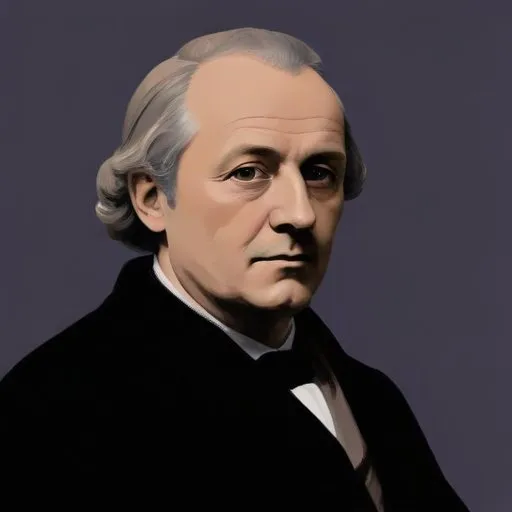
A key figure in the German Enlightenment, this philosopher and author is known for his critiques of rationalism and advocacy for the importance of emotion, intuition, and individual experience.
Johann Georg Hamann, a German Lutheran philosopher, is renowned for being one of the leading figures of post-Kantian philosophy and a key influence on prominent thinkers such as Immanuel Kant, Johann Gottfried Herder, and Søren Kierkegaard. He is also recognized as the inspiration behind the Sturm und Drang movement and a precursor to Romanticism.
Born on August 27, 1730, in Königsberg, Prussia (now Kaliningrad, Russia), Hamann initially studied theology at the University of Königsberg. He later switched to pursuing a career in business, working as a clerk in a mercantile house, and eventually held various small public offices. Despite his busy schedule, Hamann dedicated his leisure time to reading philosophy, laying the foundation for his future intellectual pursuits.
In 1758, Hamann underwent a profound mystical experience in London, which led to a Christian conversion. This transformative event reoriented his entire life and philosophy, as he began to view the Bible as the prophetic illuminating power that guides human understanding of nature, reason, and identity. This shift significantly influenced his subsequent work, shaping his views on various aspects of philosophy.
Hamann's philosophical contributions are characterized by his emphasis on the importance of language and its role in shaping human understanding. Long before the linguistic turn, he believed that epistemology should be replaced by the philosophy of language. He also argued that human reason is fallible and that knowledge is acquired through experience and intuition rather than pure reason.
Hamann's work had a significant impact on German philosophy, influencing prominent thinkers such as Kant, Herder, and Kierkegaard. His translation of David Hume's work into German is credited by most scholars as the one that awakened Kant from his "dogmatic slumber." Hamann and Kant held each other in mutual respect, despite their differing views on certain aspects of philosophy.
Some of Hamann's notable works include:
Johann Georg Hamann's philosophical contributions have had a lasting impact on the development of German philosophy, Romanticism, and the Counter-Enlightenment. His emphasis on the importance of language and experience has influenced generations of philosophers, and his work continues to be studied and appreciated by scholars today.
Throughout his life, Hamann maintained a strong sense of humility and simplicity, choosing to live a quiet, unassuming life despite his intellectual accomplishments. He passed away on June 21, 1788, leaving behind a rich legacy of philosophical thought and inspiration.
"The writer's task is to get his message across, not to make a lyrical impression." - Johann Georg Hamann
By exploring Hamann's life, work, and philosophical contributions, we can gain a deeper understanding of the complex and nuanced ideas that have shaped the course of modern philosophy.
Born in 1724
Developed influential philosophical frameworks, such as the Critique of Pure Reason, that shaped modern Western thought on ethics, morality, and human understanding.
Born in 1712
A pioneering thinker who shaped modern democracy and education with his ideas on social contracts, general will, and the importance of early childhood education. His writings influenced the French Revolution and modern political thought.
Born in 1694
A witty and insightful 18th-century writer and philosopher who used satire to critique societal norms and advocate for reason, tolerance, and human rights.
Born in 1729
A prominent Enlightenment thinker, he's known for his influential writings on philosophy, literature, and theology, which helped shape modern German culture. He's also credited with developing the concept of dramatic irony in literature.
Born in 1729
A leading figure of the Haskalah, the Jewish Enlightenment, who sought to reconcile traditional Judaism with modern European philosophy and culture. He's known for his efforts to integrate Jews into European society.
Born in 1788
A pessimistic philosopher who wrote about the human condition, emphasizing the struggles and sufferings of life, and is famous for his concept of the "will to life".
Born in 1749
A German literary giant who penned iconic works like "Faust" and "The Sorrows of Young Werther", shaping the Romantic movement and influencing countless writers.
