


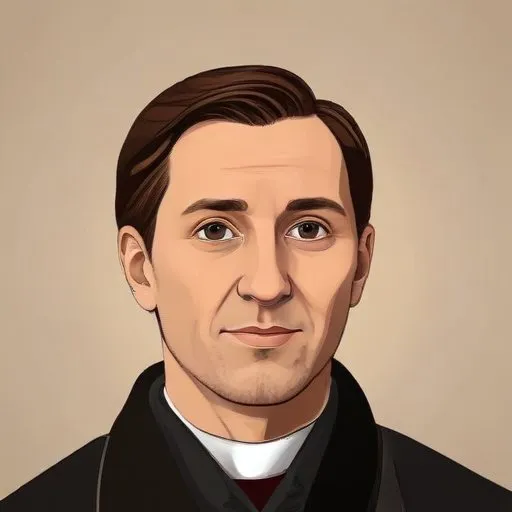
A 16th-century Swiss theologian who played a key role in shaping the Reformed tradition, contributing to the development of Calvinism and leaving a lasting impact on Christian theology.
Johann Jakob Grynaeus was a renowned Swiss Protestant divine, celebrated for his contributions to the fields of theology, biblical exegesis, and education. He is best known for his commentaries on various books of the Old and New Testament, as well as his collection of patristic literature, Monumenia S. patrum orthodoxographa.
Born on October 1, 1540, in Bern, Switzerland, Grynaeus was the son of Thomas Grynaeus, a professor of ancient languages and pastor. He received his education at Basel, where he was deeply influenced by the humanist traditions of his uncle, Simon Grynaeus.
In 1563, Grynaeus proceeded to Tübingen to pursue advanced theological studies. Here, he became embroiled in a controversy surrounding the Lutheran doctrine of the Lord's Supper, eventually renouncing the Formula of Concord. This marked a significant turning point in his theological journey, as he began to identify with the Reformed tradition.
In 1575, Grynaeus was appointed to the chair of Old Testament exegesis at Basel, where he became involved in controversy with Simon Sulzer and other Lutheran orthodox proponents. In 1584, he accepted an invitation to assist in the restoration of the University of Heidelberg.
Upon his return to Basel in 1586, Grynaeus was appointed Antistes (superintendent of the church) and professor of New Testament. For over 25 years, he exerted significant influence on both the church and state affairs of Basel, earning a reputation as a skilled theologian of the Zwinglian school.
Despite becoming totally blind five years before his death, Grynaeus continued to preach and lecture until his passing on August 13, 1617, at the age of 76. His contributions to theology, education, and patristic literature have left an indelible mark on the Protestant tradition, cementing his place as a prominent figure in the history of Christian thought.
Through his life and work, Grynaeus embodied the values of scholarly rigor, theological nuance, and pastoral dedication, inspiring generations of scholars and theologians to come.
Born in 1484
Leader of the Swiss Reformation, advocating for church reform and inspiring other Protestant movements.
Born in 1509
A French pastor and theologian who played a key role in the Protestant Reformation, shaping Christian theology and influencing Western civilization. He's famous for his teachings on predestination and his role in establishing Calvinism.
Born in 1483
A German monk and priest who sparked the Protestant Reformation, challenging Catholic Church authority and shaping Western Christianity. He's famous for nailing 95 theses to a church door, sparking a religious revolution.
Born in 1497
A 16th-century Renaissance scholar who made significant contributions to the development of the Protestant Reformation and education, known for his theological writings and astronomical observations.
Born in 1504
A prominent figure in the Swiss Reformation, he played a key role in shaping Protestant theology and wrote influential works on covenant theology. His writings had a lasting impact on Reformed Christianity.
Born in 1519
A 16th-century French theologian and scholar who played a key role in shaping Protestantism, particularly Calvinism, through his writings and teachings. He's also known for his Greek New Testament translation.
Born in 1623
A 17th-century Reformed theologian and academic who wrote influential works on Calvinism, shaping Protestant theology and education. His writings remain a significant reference for Reformed scholars today.
Born in 1554
A 16th-century Jesuit theologian who wrote influential works on moral theology, particularly on the concept of probabilism, which allowed for greater flexibility in moral decision-making.
