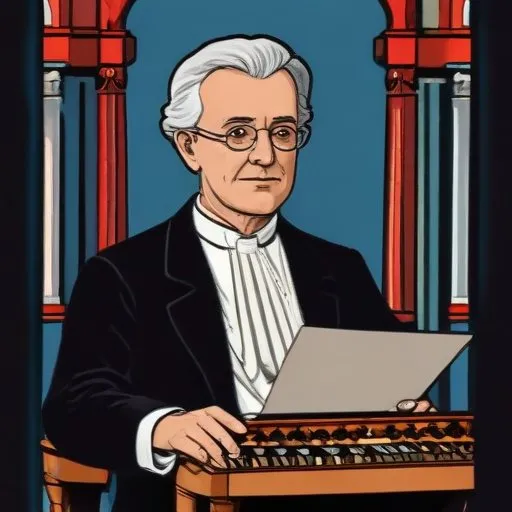
Johann Nikolaus Hanff

Johann Nikolaus Hanff

Johann Nikolaus Hanff was born on September 25th, 1663

Full Name: Johann Nikolaus Hanff
Profession: Organist
Nationality: German
Birthplace: Unknown
Birth Date: 1663
Death Date: 1717
Notable Works: Organ music
Style: Baroque

A renowned Baroque-era organist and composer, known for his intricate and expressive works for the organ, particularly his fugues and chorales.

Written by: Rajesh Kumar Rajesh Kumar

Johann Nikolaus Hanff: The North German Organist and Composer Who Left an Indelible Mark on Music

A Master of Rich Ornamentation and Slow-Moving Melodies

Johann Nikolaus Hanff was a renowned North German organist and composer, celebrated for his unique style that featured slow-moving melodies adorned with rich ornamentation, accompanied by a subtle yet evocative harmony. His compositions, characterized by a distinctive blend of elegance and complexity, earned him a special place in the hearts of music connoisseurs, including the illustrious Dieterich Buxtehude.

Early Life and Training

Born on September 25, 1663, in Wechmar, Thuringia, Hanff was exposed to the world of music from a young age. His early training and education laid the foundation for his future success as a composer and organist.

A Distinguished Career

Hanff's professional career was marked by several significant milestones. In 1696, he became the organist and conductor to the Bishop of Lübeck, a position that catapulted him to prominence in the musical circles of the time. His subsequent stints in Hamburg and Schleswig further cemented his reputation as a master of his craft.

Mentor to a Young Johann Mattheson

During his Hamburg years, Hanff had the opportunity to teach harpsichord and composition to a young Johann Mattheson, who would later become a renowned composer, music theorist, and close friend of George Frideric Handel. This mentorship played a significant role in shaping Mattheson's early musical development.

A Legacy That Transcends Time

Hanff's untimely death on December 25, 1711, at the age of 48, was a loss to the musical world. However, his legacy continued to inspire future generations of composers and musicians. In 1997, an asteroid was named after him, a testament to his enduring impact on the world of music.

Personal Life and Family

After the death of Bishop August Friedrich and the dissolution of the court in 1705, Hanff returned to Hamburg, where he started a family. Two children were born to him in 1706 and 1711, shortly before his appointment as organist at Schleswig Cathedral, a position he held until his passing.

A Lasting Impact on Music

Hanff's contributions to the world of music are multifaceted and far-reaching. His unique compositional style, which emphasized ornate melodies and subtle harmonies, influenced a generation of composers. His mentorship of Johann Mattheson, who went on to become a prominent figure in the musical circle, further solidified his legacy.

Today, Hanff's music continues to enchant audiences, offering a glimpse into the rich cultural heritage of 17th-century Germany. His life and works serve as a testament to the power of music to transcend time and touch hearts across the centuries.

In Conclusion

Johann Nikolaus Hanff's remarkable career, marked by his distinctive compositional style, his mentorship of a young Johann Mattheson, and his lasting impact on music, has secured his place in the pantheon of great North German organists and composers. As we celebrate his life and legacy, we are reminded of the enduring power of music to inspire, to uplift, and to bring people together.

Timeline
1663
Born in Weimar
Johann Nikolaus Hanff was born in Weimar, Germany. He would go on to become a renowned German organist and composer.
1696
Appointed Court Organist
Hanff was appointed Court Organist to the Duke of Weimar, a prestigious position.
1700
Composed Harmonica Sacra
Hanff composed his famous Harmonica Sacra, a collection of sacred music for the organ.
1711
Death
Johann Nikolaus Hanff passed away, leaving behind a legacy of beautiful music and contributions to the organ repertoire.
1711
Buried in Weimar
Hanff was buried in Weimar, where many of his ancestors lay rest.
Johann Nikolaus Hanff

Johann Nikolaus Hanff Quiz

What is Johann Nikolaus Hanff primarily known for?

Score: 0/5
FAQ
What is Johann Nikolaus Hanffs significance in the history of organ music?
Johann Nikolaus Hanff was a prominent German organist and composer of the Baroque period. He made significant contributions to the development of organ music, particularly in the genres of fugue and chorale.
What is Johann Nikolaus Hanffs most famous composition?
Johann Nikolaus Hanffs most famous composition is his Fugue in D minor, which showcases his mastery of counterpoint and fugue technique.
What was Johann Nikolaus Hanffs role in the Hamburg opera scene?
Johann Nikolaus Hanff was a prominent figure in the Hamburg opera scene, where he worked as an organist and composer. He wrote several operas, including Andromeda and Diana am Tage.
What is Johann Nikolaus Hanffs connection to the Hamburg Opera House?
Johann Nikolaus Hanff was instrumental in the establishment of the Hamburg Opera House, where he served as the director and principal composer.
What is Johann Nikolaus Hanffs legacy in music?
Johann Nikolaus Hanffs legacy in music is that of a master organist and composer who made significant contributions to the development of Baroque music, particularly in the genres of fugue and chorale.

Related People:

Johann Sebastian Bach

Born in 1685

A master of Baroque music, he composed over 1,000 works, including orchestral suites, cantatas, and passions, that still inspire and influence musicians today. His innovative use of counterpoint and harmony raised the bar for classical music.

George Frideric Handel

Born in 1685

A renowned Baroque composer and organist, famous for creating majestic orchestral suites, operas, and oratorios, including the iconic "Messiah" masterpiece.

Heinrich Schütz

Born in 1585

A renowned Baroque composer and organist, known for his contributions to the development of the oratorio and passion genres, creating over 500 works that showcased his mastery of choral music.

Samuel Scheidt

Born in 1587

A renowned Baroque-era musician and teacher, known for his influential compositions and contributions to the development of the organ concerto.

Michael Altenburg

Born in 1584

A 17th-century theologian and composer who wrote sacred music and hymns, contributing to the development of Lutheran church music.