


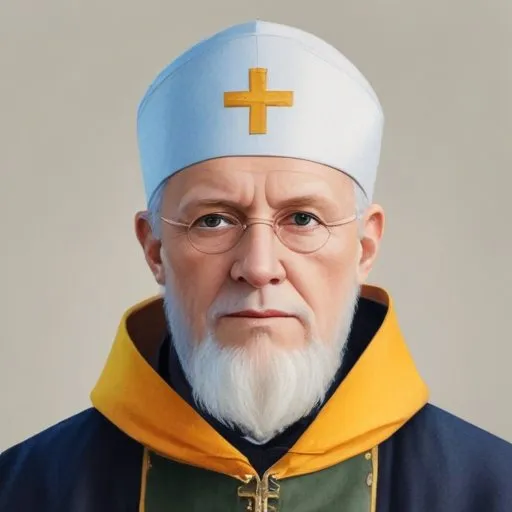
A 16th-century Swedish archbishop and theologian who played a key role in the Swedish Reformation and wrote extensively on theology and church history. He's also known for his historical writings on Sweden's early Christian era.
Johannes Magnus, a renowned theologian, genealogist, and historian, is best known as the last functioning Catholic Archbishop in Sweden, playing a crucial role in the country's tumultuous transition to Lutheranism during the 16th century. His scholarly works, particularly Historia de omnibus Gothorum Sueonumque regibus and Historia metropolitan ecclesiae Upsalensis, remain seminal sources of Swedish history and culture.
Born on March 19, 1488, in Linköping, Sweden, Magnus was the son of Mns Pedersson, a burgess, and Kristina Kruse. His humble origins belie his eventual rise to prominence in the Swedish hierarchy. Magnus's intellectual prowess earned him recognition, and he was subsequently selected by Gustav I Vasa to become Archbishop in 1523.
However, Magnus's appointment was met with opposition from Pope Clement VII, who declared the deposition of the previous Archbishop, Gustav Trolle, unlawful. Undeterred, Gustav Vasa installed Magnus without papal acceptance, precipitating a rift between the Swedish monarchy and the Vatican. Magnus's own reservations about the Lutheran teachings of the Petri brothers, Olaus and Laurentius, further complicated his position.
In 1526, Magnus was sent to Russia as a diplomat, where he remained in self-imposed exile, aware that his presence in Sweden was no longer desired. During this period, he devoted himself to historical and literary pursuits, producing two monumental works: Historia de omnibus Gothorum Sueonumque regibus, a comprehensive history of Sweden's Gothic and Swedish kings, and Historia metropolitan ecclesiae Upsalensis, a history of the Archbishopric of Uppsala.
Despite being overlooked in his native Sweden, Magnus's scholarly contributions have had a lasting impact on Swedish historiography and culture. His works continue to be consulted by scholars and historians, providing invaluable insights into Sweden's complex past. As a testament to his legacy, Magnus remains an important figure in the country's cultural heritage.
As a theologian and historian, Magnus's works reflect his deep commitment to understanding the complexities of Swedish history and culture. His writings demonstrate a nuanced appreciation for the country's Catholic heritage, as well as its gradual transition to Lutheranism. Magnus's own struggles with the Lutheran teachings of the Petri brothers underscore his steadfast dedication to preserving Sweden's Catholic traditions.
Johannes Magnus's legacy extends beyond the realm of academia, influencing Sweden's cultural identity and informing the country's understanding of its rich history. His works have inspired generations of scholars, historians, and writers, cementing his position as a pivotal figure in Swedish cultural heritage.
Born in 1483
A German monk and priest who sparked the Protestant Reformation, challenging Catholic Church authority and shaping Western Christianity. He's famous for nailing 95 theses to a church door, sparking a religious revolution.
Born in 1509
A French pastor and theologian who played a key role in the Protestant Reformation, shaping Christian theology and influencing Western civilization. He's famous for his teachings on predestination and his role in establishing Calvinism.
Born in 1484
Leader of the Swiss Reformation, advocating for church reform and inspiring other Protestant movements.
Born in 1497
A 16th-century Renaissance scholar who made significant contributions to the development of the Protestant Reformation and education, known for his theological writings and astronomical observations.
Born in 1489
Leader of the English Reformation, instrumental in creating the Church of England and authoring the Book of Common Prayer.
Born in 1504
A prominent figure in the Swiss Reformation, he played a key role in shaping Protestant theology and wrote influential works on covenant theology. His writings had a lasting impact on Reformed Christianity.
