


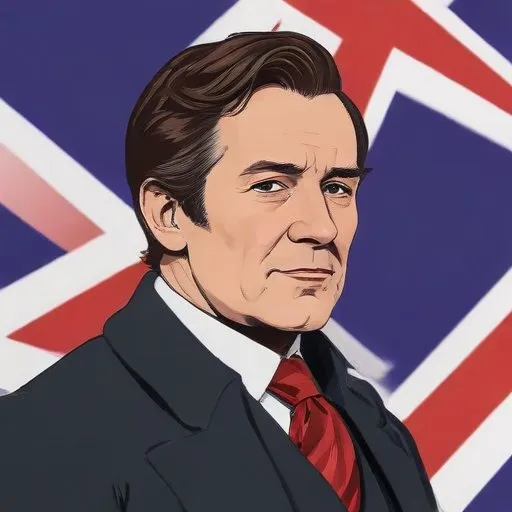
Scottish general and politician who served as Lord High Commissioner to the Parliament of Scotland, playing a key role in the Acts of Union in 1707. He's known for his military campaigns and political maneuvering.
John Campbell, 2nd Duke of Argyll, is renowned for his illustrious military career, serving as a senior commander in the British Army during the Nine Years War and the War of the Spanish Succession. As a skilled tactician and leader, he played a pivotal role in several key battles, including the Siege of Kaiserswerth and the Battle of Sheriffmuir.
Born on October 10, 1680, at Ham House, John Campbell was the son of Archibald Campbell, 1st Duke of Argyll, and Elizabeth Campbell ne Tollemache, daughter of Sir Lionel Tollemache, 3rd Baronet. His mother's stepfather, John Maitland, Duke of Lauderdale, was a dominant figure in Scotland during Charles II's reign. Campbell's early years were marked by turmoil, with his grandfather, Archibald Campbell, 9th Earl of Argyll, leading Argyll's Rising against James II of England and VII of Scotland, resulting in his execution in Edinburgh in 1685.
Despite this tumultuous start, Campbell received a solid education, being privately tutored by Walter Campbell of Dunloskin, John Anderson of Dumbarton, and Alexander Cunningham. This strong educational foundation prepared him for his future military career.
Campbell's military career began in 1694, when he was commissioned as colonel of Lord Lorne's Regiment of Foot, a regiment entirely raised by the Argyll family. He served briefly on the European continent during the Nine Years War before the regiment was disbanded in 1698. This experience laid the groundwork for his later successes on the battlefield.
During the War of the Spanish Succession, Campbell fought at the Siege of Kaiserswerth and later became a brigade commander. He was subsequently given command of all British forces in Spain, where he conducted a successful evacuation of troops at the instigation of the Harley Ministry. This achievement earned him recognition as a skilled military leader.
In 1715, Campbell led the government army against the Jacobite forces led by the Earl of Mar at the Battle of Sheriffmuir. Although the battle was tactically inconclusive, it marked a significant turning point in the Jacobite Rebellion, as the government forces ultimately emerged victorious.
After Sheriffmuir, Campbell went on to serve as Commander-in-Chief, Scotland, and later as Lord Steward and Master-General of the Ordnance under the Walpole-Townshend Ministry. These positions demonstrated the esteem in which he was held by his contemporaries and the British government.
John Campbell, 2nd Duke of Argyll, left an indelible mark on British military history, earning a reputation as a skilled tactician and leader. His military achievements, particularly during the War of the Spanish Succession and the Jacobite Rebellion, solidified his position as one of Scotland's most notable noblemen and military commanders.
Through his life and career, Campbell exemplified the values of courage, duty, and leadership, inspiring future generations of military leaders and cementing his place in the annals of Scottish and British history.
Born in 1274
Led Scotland during the First War of Scottish Independence, ultimately securing a decisive victory at the Battle of Bannockburn and earning recognition as the country's rightful king. He's celebrated for his bravery, strategic thinking, and unwavering commitment to Scottish freedom.
Born in 1630
The last monarch of the House of Stuart, restored to the throne after a republican Commonwealth, known for his lavish spending, mistresses, and the Great Fire of London. He ruled with a mix of absolutism and indulgence, shaping England's Restoration era.
Born in 1599
Leader of the Parliamentarian forces during the English Civil War, who later ruled England, Scotland, and Ireland as a republican dictator, known for his military victories and radical reforms.
Born in 1566
First king of both Scotland and England, uniting the crowns under a single monarch, and known for his role in the translation of the Bible into English.
Born in 1630
The last monarch of the House of Stuart, restored to the throne after a republican Commonwealth, known for his lavish spending, mistresses, and the Great Fire of London. He ruled with a mix of absolutism and indulgence, shaping England's Restoration era.
Born in 1633
The last Catholic monarch of England, Scotland, and Ireland, who attempted to restore Catholicism and absolute monarchy, sparking the Glorious Revolution. He's infamous for his authoritarian rule and religious intolerance.
Born in 1650
The Prince of Orange, King of England, Scotland, and Ireland, led the Glorious Revolution, overthrowing the Catholic King James II, and ruled with his wife Mary II, establishing a Protestant monarchy. He's also known for his military victories in Ireland and Europe.
Born in 1516
The first queen to rule England in her own right, Bloody Mary tried to restore Catholicism, earning her notorious reputation for burning hundreds of Protestants at the stake.
