


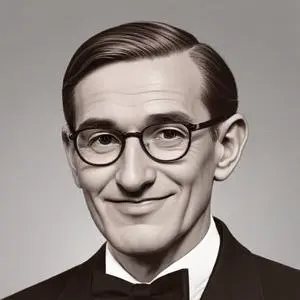
A Nobel Prize-winning economist who developed the IS-LM model, a fundamental framework for understanding macroeconomic policy and its effects on the economy.
Sir John Richard Hicks, a prominent British economist, left an indelible mark on the field of economics with his groundbreaking contributions to consumer demand theory, macroeconomics, and general equilibrium theory. His work, spanning over six decades, earned him the Nobel Memorial Prize in Economic Sciences in 1972, cementing his status as one of the most influential economists of the 20th century.
Hicks was born on April 8, 1904, in Warwick, England, to Edward Hicks, a journalist, and Dorothy Catherine Stephens. His educational journey began at Clifton College, where he developed a strong foundation in mathematics. He later pursued his interests at Balliol College, Oxford, graduating with second-class honors in 1926.
Hicks' academic career began at the London School of Economics and Political Science, where he lectured from 1926 to 1935. During this period, he transitioned from labor economics to analytical economics, leveraging his mathematical background. His associations with prominent economists like Lionel Robbins, Friedrich von Hayek, and Nicholas Kaldor further enriched his understanding of the subject.
In 1935, Hicks joined Cambridge University, where he was a fellow of Gonville and Caius College. His work during this period focused on developing the IS-LM model, which provided a Keynesian perspective on macroeconomics. His seminal book, Value and Capital, published in 1939, extended general equilibrium theory and value theory, solidifying his reputation as a leading economist.
In 1935, Hicks married Ursula Webb, a fellow economist, and the couple shared a lifelong partnership. Hicks' interests extended beyond economics to literature and history, reflecting his diverse intellectual pursuits.
Sir John Hicks' work has had a profound impact on modern economic theory, influencing generations of economists and policymakers. His contributions continue to shape our understanding of consumer behavior, macroeconomic policy, and general equilibrium theory, earning him a permanent place in the pantheon of economic thought.
Hicks' legacy serves as a testament to the power of rigorous intellectual inquiry, inspiring future economists to build upon his foundation and continue pushing the boundaries of knowledge.
92 Years Old
A renowned economist and philosopher who has made significant contributions to welfare economics, social choice theory, and development economics, and is known for his work on poverty, famine, and human development.
Born in 1915
A renowned economist and academic who made significant contributions to the field of economics, particularly in the areas of macroeconomics and international trade. He was awarded the Nobel Prize in Economics in 1970.
Born in 1883
A pioneering economist who revolutionized modern economic theory with his groundbreaking ideas on government intervention and fiscal policy, shaping global economic policies.
Born in 1912
A Nobel Prize-winning economist who championed free market capitalism and limited government intervention, known for his advocacy of laissez-faire economics and influential writings on monetary policy.
83 Years Old
A Nobel Prize-winning economist and academic who has made significant contributions to the field of economics, particularly in the areas of information economics and globalization.
86 Years Old
A Nobel Prize-winning economist who developed the concept of "information asymmetry," which explains how unequal access to information affects markets and transactions. His work has far-reaching implications for understanding economic behavior and policy-making.
Born in 1924
A Nobel Prize-winning economist who developed a growth model that showed technological progress is the primary driver of economic growth, and is known for his work on the theory of economic growth.
Born in 1920
Developed econometric models that accurately predicted economic trends and fluctuations, earning him the Nobel Prize in Economics in 1980.
