


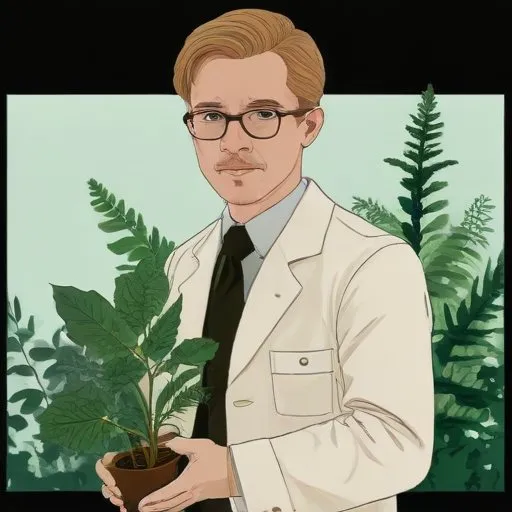
A Swedish botanist and biologist who cataloged and described numerous plant species, contributing significantly to the field of taxonomy. His work laid the foundation for future botanical discoveries.
Jonas Carlsson Dryander was a renowned Swedish botanist who made significant contributions to the field of natural history, particularly in the 18th century. He is best known for his publications, including the Catalogus bibliothecae historico-naturalis Josephi Banks, a comprehensive catalog of Sir Joseph Banks' vast natural history collection.
Born on March 5, 1748, in Gothenburg, Sweden, Dryander was the son of Carl Leonard Dryander and Brita Maria Montin. He was a pupil of the illustrious Carl Linnaeus at Uppsala University, laying the foundation for his future accomplishments in botany. In 1778, he entered Lund University, where he earned his Master of Philosophy degree.
In 1777, Dryander arrived in London, where he became associated with Sir Joseph Banks, a prominent naturalist and patron of the sciences. Following the death of Swedish naturalist Daniel Solander in 1782, Dryander took on the role of librarian of the Royal Society and vice-president of the Linnean Society of London. This position allowed him to further his research and collaborate with other prominent scientists of the time.
Dryander's most notable publication is the Catalogus bibliothecae historico-naturalis Josephi Banks, a five-volume work that took him over 15 years to complete. This extensive catalog of Banks' natural history collection is still considered an essential reference for botanists and natural historians today.
In 1784, Dryander was elected a foreign member of the Royal Swedish Academy of Sciences, a testament to his contributions to the field of botany. In recognition of his work, the genus Dryandra was named in his honor by his friend and fellow scientist Carl Peter Thunberg. Additionally, Robert Brown named the species Grevillea dryandri in his honor.
Jonas Carlsson Dryander's contributions to botany and natural history have left a lasting impact on the scientific community. His dedication to cataloging and preserving knowledge has facilitated the work of future generations of scientists. Today, his legacy serves as a reminder of the importance of meticulous research and collaboration in advancing our understanding of the natural world.
Born in 1701
A Swedish astronomer, physicist, and mathematician who developed the Celsius temperature scale, still widely used today to measure temperature. He also made significant contributions to astronomy, including the discovery of the aurora borealis.
Born in 1716
A Swedish-Finnish botanist and explorer who traveled to North America in the 1740s to study its natural history, documenting new species and providing valuable insights into the region's flora and fauna.
Born in 1688
A 17th-century polymath who made significant contributions to astronomy, philosophy, and theology, and is most known for his mystical writings on the nature of God and the afterlife.
Born in 1706
A founding father of the United States, he was a leading figure in the Enlightenment, known for his groundbreaking inventions, scientific discoveries, and influential writings. He played a key role in shaping American history and politics.
Born in 1743
A Swedish scientist who made significant contributions to the fields of botany, entomology, and psychology, particularly in the discovery of new plant and insect species. He's also known as the "father of South African botany" for his extensive research on the region's flora.
Born in 1748
A Swedish physician and activist who traveled with Captain James Cook on his second voyage, documenting indigenous cultures and advocating for abolition of slavery.
