


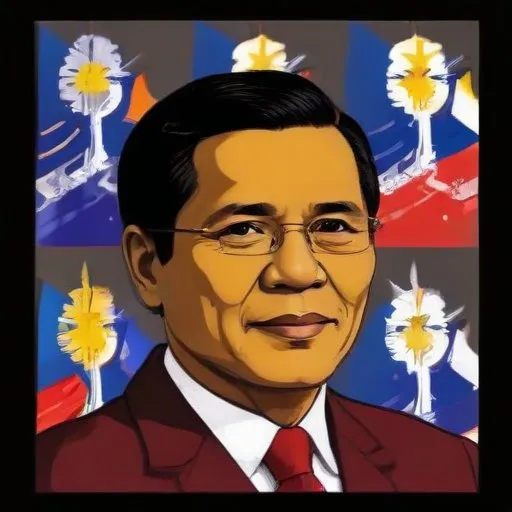
A Filipino lawyer and politician who served as President of the Philippines during the Japanese occupation, known for his controversial role in the country's history.
Jos P. Laurel is known for serving as the President of the Japanese-occupied Second Philippine Republic, a puppet state during World War II, from 1943 to 1945. This tenure would shape his legacy and spark controversy, as he navigated the treacherous waters of collaboration and resistance.
Born on March 9, 1891, in Tanauan, Batangas, Laurel was the son of Sotero Laurel y Remoquillo and Jacoba García y Pimentel. His father had been an official in the revolutionary government of Emilio Aguinaldo and a signatory to the 1899 Malolos Constitution. Laurel's early life was marked by a strong sense of duty and public service, which would become a hallmark of his later career.
Laurel's early career was marked by a series of high-profile appointments, including stints as a judge and a senator. However, it was his role as the Secretary of Justice under President Manuel Quezon that catapulted him to national prominence.
In 1943, Laurel was appointed as the President of the Second Philippine Republic, a puppet state established by the Japanese during World War II. This move was widely seen as a collaboration with the occupying forces, and would spark controversy and debate about Laurel's legacy.
Laurel's tenure as President of the Second Philippine Republic remains a topic of heated debate. While some view him as a traitor who collaborated with the Japanese, others see him as a leader who made difficult choices to protect the Filipino people during a time of war.
Despite the controversy surrounding his presidency, Laurel was posthumously recognized as a former president of the Philippines by the administration of President Diosdado Macapagal in 1961.
Laurel's personal life was marked by a number of significant milestones, including his marriage to Pacencia Hidalgo Laurel in 1911. The couple had nine children together, and Laurel was known for his strong sense of family and duty.
Laurel was a strong believer in the importance of education and public service. Throughout his life, he advocated for the development of the Filipino people and the growth of the Philippine nation.
Jos P. Laurel's legacy is complex and multifaceted. While his collaboration with the Japanese remains a point of controversy, his commitment to public service and his role in shaping the Philippine nation cannot be denied.
As we reflect on Laurel's life and legacy, we are reminded of the complexity of history and the difficult choices that leaders must make in times of crisis.
Born in 1878
The 2nd President of the Philippines, a key figure in the country's fight for independence from the US, known for his leadership during World War II and establishing a government-in-exile.
Born in 1878
The 4th President of the Philippines, a lawyer and politician who played a key role in the country's transition from American colonial rule to independence. He's most known for his efforts in rebuilding the war-torn nation after World War II.
Born in 1910
A Filipino diplomat and politician who served as a senator and secretary of foreign affairs, known for his strong anti-Marcos stance and advocacy for human rights. He ran for president in 1986 but lost to Corazon Aquino.
Born in 1917
A Filipino leader who ruled with an iron fist, implementing martial law and amassing wealth, leaving a legacy of controversy and economic turmoil.
93 Years Old
First female president of the Philippines, led the People Power Revolution, and restored democracy after decades of authoritarian rule.
98 Years Old
The 12th President of the Philippines, a decorated war hero and leader who implemented economic reforms and brought stability to the country after a tumultuous era. He's known for his efforts to modernize the Philippines and promote national unity.
89 Years Old
The 13th President of the Philippines, a former actor turned politician, is known for his populist appeal and controversial presidency marked by corruption allegations and an eventual impeachment trial. He's also remembered for his efforts to address poverty and inequality.
79 Years Old
The 14th President of the Philippines, a prominent figure in Southeast Asian politics, known for her economic reforms and controversial tenure marked by allegations of corruption and human rights abuses.
