


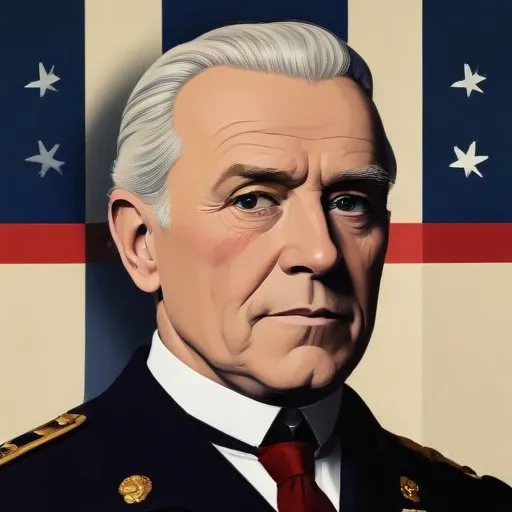
A Confederate general who fought in the American Civil War and later served as a US congressman, known for his military bravery and political service.
Joseph Wheeler, fondly known as "Fighting Joe," was a military commander and politician of the Confederate States of America, renowned for his bravery and tactical prowess as a cavalry general in the Civil War.
Born on September 10, 1836, near Augusta, Georgia, Wheeler spent his early years between Georgia and Derby, Connecticut, where his relatives resided. His parents, Joseph Wheeler and Julia Knox Hull Wheeler, instilled in him a strong sense of patriotism, which would later define his military career.
Wheeler's ancestry traced back to the English Puritans who settled in New England during the Puritan migration. His maternal grandfather, Brigadier General William Hull, was a veteran of the American Revolution. Despite his mixed upbringing, Wheeler identified as a Georgian and Southerner.
In 1854, Wheeler entered the United States Military Academy at West Point, graduating 19th out of 22 cadets in 1859. He was commissioned as a brevet second lieutenant in the 1st U.S. Dragoons and later attended the U.S. Army Cavalry School in Carlisle, Pennsylvania.
Wheeler's military career spanned multiple conflicts, including the American Civil War, the Spanish-American War, and the Philippine-American War. During the Civil War, he fought in numerous battles in the Western Theater as the senior cavalry general in the Army of Tennessee.
Between the Civil War and the Spanish-American War, Wheeler served multiple terms as a U.S. Representative from the state of Alabama as a Democrat. His political career was marked by his commitment to his constituents and his advocacy for veterans' rights.
Joseph Wheeler's legacy is multifaceted, reflecting his military prowess, political acumen, and personal convictions. He was a formidable cavalry general, a dedicated politician, and a proud Southerner.
Wheeler's impact on modern society can be seen in his contributions to the development of the U.S. military, particularly in the areas of cavalry warfare and tactics. His political career paved the way for future generations of politicians from the South.
Wheeler's nickname "Fighting Joe" was earned during a skirmish with Indians in New Mexico, where he demonstrated exceptional bravery and combat skills.
Despite his many accomplishments, Wheeler remained humble and grounded, crediting his success to his upbringing and the values instilled by his family.
"The soldier's greatest virtue is fortitude, and his greatest vice is cowardice."
"The true test of a warrior is not in the battles he wins, but in the scars he bears."
Born in 1822
Led the Union Army to victory in the Civil War and later became President, known for issuing the Emancipation Proclamation and strengthening federal authority.
Born in 1820
A renowned Union general during the American Civil War, he's infamous for his scorched earth tactics and march through the Confederacy, leaving destruction in his wake.
Born in 1815
Led the Union Army to victory in the Battle of Gettysburg, a turning point in the American Civil War, and later oversaw the construction of the Washington Aqueduct.
Born in 1831
A Confederate general during the American Civil War, known for his bravery and aggressive tactics, but also criticized for his reckless decisions that led to devastating defeats.
Born in 1821
A Confederate general during the American Civil War, later serving as a diplomat and ambassador to Turkey, known for his military strategies and post-war reconciliation efforts.
Born in 1818
A Confederate general who played a pivotal role in the American Civil War, particularly during the Battle of Fort Sumter, and is often credited with starting the war.
Born in 1807
Led the Confederate States Army during the American Civil War, surrendering to Union forces at Appomattox, marking the war's effective end.
Born in 1824
A Confederate general during the American Civil War, he's renowned for his unconventional tactics and bravery, earning him a legendary status among military historians.
