


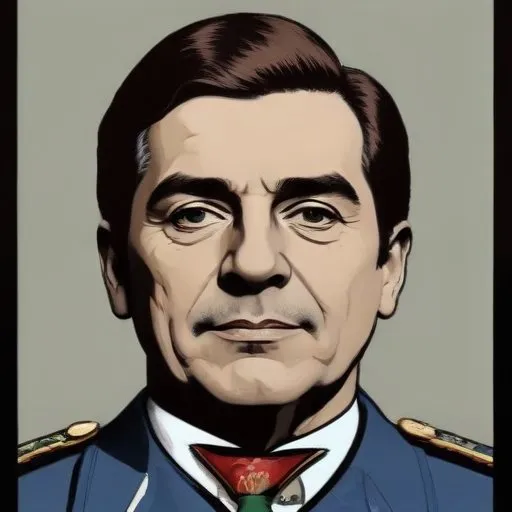
Argentinian general and politician who served as the 6th Governor of Buenos Aires Province, playing a key role in the country's early independence and development. He's also known for his military campaigns against the Spanish.
Juan Ramón Balcarce, a renowned Argentine military leader and politician, is best known for his bravery in fighting against the British in 1807 and his significant contributions to the country's struggle for independence. As a prominent figure in Argentine history, Balcarce served as the governor of Buenos Aires twice, first from 1818 to 1820 and again in 1832, leaving an indelible mark on the nation's development.
Born on March 16, 1773, Balcarce was the elder brother of Antonio González de Balcarce and Marcos González de Balcarce. He joined the military at a young age, demonstrating his valiant spirit and leadership skills in the battle against the British in 1807. His military prowess earned him recognition, and he was commissioned to lead the 1812-1813 military campaign in Upper Peru under General Manuel Belgrano.
Following his military success, Balcarce entered the world of politics, becoming a respected leader in Argentine politics. He served as the defense minister under the government of Juan Manuel de Rosas, displaying his diplomatic and strategic abilities. In 1832, he was elected governor of Buenos Aires for the second time, solidifying his position as a prominent figure in Argentine politics.
However, Balcarce's career was not without controversy. On October 11, 1833, the city was filled with announcements of a trial against Rosas, and a massive demonstration erupted at the gates of the legislature, calling for Balcarce's resignation. The troops, who were supposed to quell the demonstration, instead mutinied and joined the protesters. The legislature eventually succumbed to the pressure, ousting Balcarce from office and replacing him with Juan José Viamonte.
Following his removal from office, Balcarce was imprisoned and eventually exiled to Concepción del Uruguay, where he died on November 12, 1836. Despite the tumultuous end to his political career, Balcarce's contributions to Argentine independence and his bravery in battle have cemented his place in the nation's history.
Balcarce's legacy extends beyond his military and political achievements. He played a crucial role in shaping Argentina's development, and his commitment to independence inspired generations of Argentine leaders. His story serves as a testament to the power of courage, determination, and strategic leadership in the face of adversity.
Born in 1778
Led the successful fight for independence in Argentina, Chile, and Peru, and is revered as a national hero in these countries. He's also credited with creating the Army of the Andes, a crucial force in the Latin American wars of independence.
Born in 1770
A key figure in Argentina's struggle for independence, he created the country's flag and played a crucial role in its early development.
Born in 1774
A 19th-century leader who played a key role in Argentina's struggle for independence, serving as the country's Supreme Director and leading military campaigns against Spanish royalists. He's remembered for his bravery and strategic prowess.
Born in 1821
A 19th-century leader who modernized Argentina's economy and infrastructure, and is also revered for his literary and journalistic contributions.
Born in 1811
A pioneering journalist and politician who modernized Argentina's education system and infrastructure, earning him the nickname "Father of Education" in Argentina.
Born in 1852
The 19th President of Argentina, a key figure in the country's Radical Civic Union, known for his populist policies and efforts to reduce inequality. He's remembered for his strong leadership during a time of great social change.
