


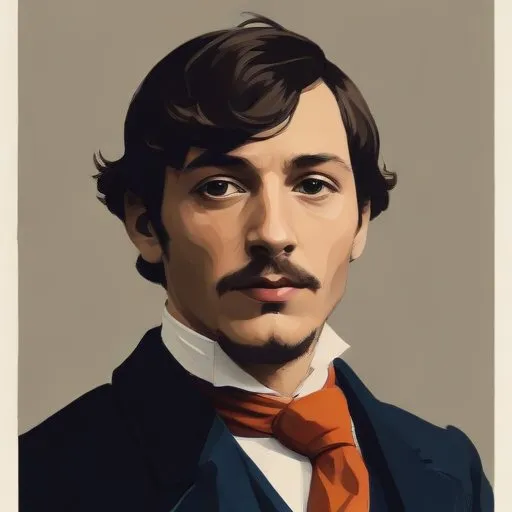
A French painter who created realistic and intimate portraits of rural life, capturing the beauty of everyday moments. Known for his innovative use of natural light and color.
Jules Bastien-Lepage, a French painter, is renowned for his groundbreaking contributions to the art world, bridging the gap between Realism and Impressionism. His en plein air depictions of peasant life in the countryside, infused with sensitivity and authenticity, paved the way for a new artistic movement, earning him the title of "impressionism corrected, sweetened and adapted to the taste of the crowd" by Émile Zola.
Born on November 1, 1848, in the picturesque village of Damvillers, Meuse, Bastien-Lepage grew up surrounded by the rolling hills and vineyards that would later feature prominently in his artwork. His father, a grape grower, and grandfather, a gardener, instilled in him a love for nature and the simple pleasures of rural life.
Young Bastien-Lepage's creativity was nurtured by his parents, who encouraged his passion for drawing by providing him with prints of paintings to copy. This early training laid the foundation for his future artistic endeavors.
Bastien-Lepage's formal training began in Verdun, where he honed his skills under the guidance of local artists. In 1867, he moved to Paris, enrolling at the École des Beaux-Arts, where he studied under the tutelage of Charles Cabanel.
Although he excelled in drawing, earning first place in his class, Bastien-Lepage's rebellious spirit led him to often skip classes, preferring to work independently. During this period, he wrote to his parents, expressing his frustration with the traditional art school approach, citing the limitations of the life model, a man posing as a mediaeval lutanist.
In 1870, Bastien-Lepage's life took a dramatic turn when he fought in the Franco-Prussian War, suffering a wound that would change the course of his life. Returning to his village, he poured his emotions into his art, capturing the essence of rural life and the people he loved.
This period of introspection and recovery led to the creation of some of his most iconic works, including "Grandfather in the Garden," which earned him his first success at the Paris Salon in 1873.
Bastien-Lepage's artistic style, characterized by its naturalism, attention to detail, and emotional depth, captivated audiences and influenced generations of artists. His pioneering work paved the way for Impressionism, earning him recognition from contemporaries like Claude Monet and Pierre-Auguste Renoir.
Today, his masterpieces, such as "Joan of Arc," reside in prestigious institutions like the Metropolitan Museum of Art in New York, serving as a testament to his innovative spirit and enduring legacy.
Bastien-Lepage's remarkable journey, marked by his unwavering dedication to his art and his unshakeable connection to the natural world, has left an indelible mark on the world of art. His contributions continue to inspire, and his legacy remains a testament to the power of creativity and innovation.
Born in 1841
A pioneer of Impressionism, creating vibrant, intimate portraits and landscapes that capture the beauty of everyday life. His works evoke a sense of joy and warmth, celebrating the human experience.
Born in 1840
A founder of Impressionism, capturing fleeting light and color in dreamy landscapes and water scenes, revolutionizing modern art.
Born in 1830
A Danish-French Impressionist painter who captured the beauty of landscapes and cityscapes with vivid colors and bold brushstrokes, influencing the development of modern art.
Born in 1832
A pioneering figure in Impressionism, he bridged the gap between Realism and Impressionism with his bold, expressive brushstrokes and everyday subjects.
Born in 1814
A pioneering painter of rural life and landscapes, capturing the beauty and hardship of peasant life, and inspiring a generation of artists with his realistic and empathetic style.
Born in 1819
A pioneer of Realism, this artist rejected idealized representations, instead depicting everyday life and people in a raw, unromanticized manner, influencing the development of modern art.
Born in 1844
A self-taught artist who created vibrant, dreamlike jungle scenes and naive portraits, blending fantasy and realism with a unique, primitive style.
Born in 1839
A landscape painter who captured the essence of rural France and England through his Impressionist works, often focusing on the fleeting effects of light and atmosphere.
