


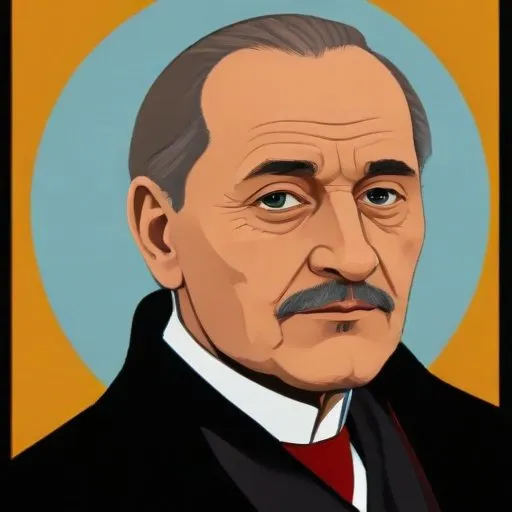
A Lithuanian poet, critic, and translator, he's known for his unique blend of folkloric and modernist styles, which greatly influenced Lithuanian literature.
Jurgis Baltruaitis was a prolific Lithuanian symbolist poet, translator, and diplomat, renowned for his contributions to Lithuanian literature and his pivotal role in the Russian Symbolist movement. His mastery of 15 foreign languages enabled him to translate works by prominent authors, including Henrik Ibsen, Oscar Wilde, and August Strindberg, leaving an indelible mark on literary circles.
Born on May 2, 1873, in Paantvardys village, near Jurbarkas, Lithuania, then under Imperial Russian rule, Baltruaitis hailed from a family of farmers. He pursued his education at Kaunas gymnasium, graduating in 1893, and later enrolled in the Faculty of Physical and Mathematical Sciences at Moscow University. His curiosity and thirst for knowledge led him to attend lectures in the Faculty of History and Philology, where he honed his expertise in foreign languages.
From 1895 onwards, Baltruaitis embarked on a literary journey, editing Moscow-based literary magazines and penning his own creative works in Russian. He became an integral part of the Russian Symbolist movement, collaborating with Sergei Polyakov to establish the publishing house Scorpio, which published prominent Russian Symbolist magazines, such as Vesy and Severnyie Tzvety, as well as collections of renowned poets.
As a distinguished member of Moscow's cultural elite, Baltruaitis forged close relationships with illustrious Russian writers and artists, including Anton Chekhov, Konstantin Balmont, Valery Bryusov, Vyacheslav Ivanov, Maksim Gorky, Konstantin Stanislavsky, Mikhail Vrubel, and Aleksandr Scriabin. Boris Pasternak, the celebrated Russian poet, even served as a private tutor to Baltruaitis' children.
Baltruaitis published three collections of poetry in Russian and another three in Lithuanian, solidifying his reputation as a master poet. He translated numerous modern literary works, including those by Henrik Ibsen, Oscar Wilde, August Strindberg, Knut Hamsun, and Gabriele D'Annunzio. His translation of Hamsun's Hunger is still regarded as a classical rendering of the work into Russian.
Jurgis Baltruaitis' remarkable literary and diplomatic achievements left an enduring legacy, influencing generations of writers, poets, and translators. His commitment to promoting Lithuanian literature and culture, as well as his involvement in the Russian Symbolist movement, have secured his place as one of the most important figures in 20th-century literary history.
Jurgis Baltruaitis passed away on January 3, 1944, leaving behind a rich literary heritage that continues to inspire and captivate readers to this day.
