


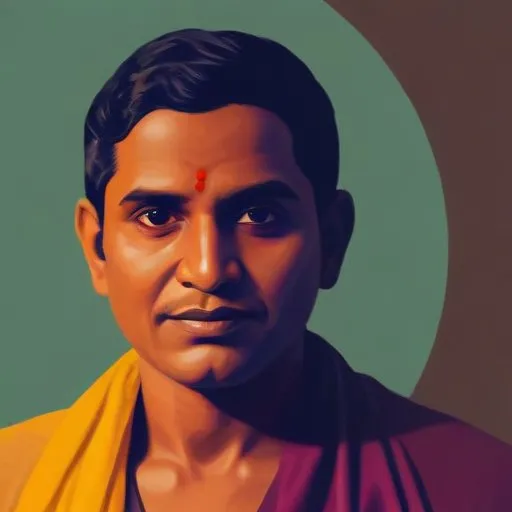
A pioneering figure in the Indian social reform movement, known for advocating women's education and emancipation, and fighting against social evils like child marriage and dowry.
Kandukuri Veeresalingam, a trailblazing social reformer and writer, is revered as the father of the Telugu Renaissance movement. He is credited with pioneering efforts to educate women, remarriage of widows, and combating child marriage and the dowry system, revolutionary ideas that shook the societal status quo of his time.
Born on April 16, 1848, in Rajahmundry, Madras Presidency, British India, Veeresalingam was adopted by his paternal uncle, Venkataratnam, after his father's untimely demise. Despite overcoming the challenges of smallpox and paternal loss, Veeresalingam's studious nature earned him the best student award in his school. He completed his matriculation in 1869 and began his career as a teacher in Korangi village.
Veeresalingam's literary prowess was unparalleled. He was a scholar in Telugu, Sanskrit, and Hindi, and his writings reflected his commitment to fighting social evils. His plays, such as Prahlada (1886) and Satya Harischandra (1886), were thought-provoking and hard-hitting. His magnum opus, Rajasekhara Charitra, published in 1880, is widely recognized as the first Telugu novel, inspired by the Irish writer's The Vicar of Wakefield.
Veeresalingam's dedication to social reform was evident in his establishment of schools and institutions. He founded a school in Dowlaiswaram in 1874, constructed the Brahmo Mandir in 1887, and built the Hithakarini School in 1908 in Andhra Pradesh. His journal, Viveka Vardhini, launched in 1887, aimed to promote women's education and empowerment.
Veeresalingam's impact on modern society is profound. He is often referred to as the "Raja Ram Mohan Roy of Andhra," and his title, "Gadya Tikkana," or the "Tikkana of Prose," is a testament to his literary prowess. His tireless efforts to promote education, women's rights, and social reform have left an indelible mark on the Telugu Renaissance movement.
Veeresalingam's contributions have been recognized and celebrated through various awards and honors. His legacy continues to inspire generations, and his name is etched in the annals of Indian history as a champion of social reform and literary excellence.
Today, Kandukuri Veeresalingam's vision of a society that values education, equality, and social justice continues to inspire and motivate individuals to work towards creating a better world.
Born in 1861
A Bengali polymath who wrote extensively on love, nature, and humanity, creating a unique blend of Indian and Western literary styles, and was the first non-European to win the Nobel Prize in Literature.
Born in 1869
Indian freedom fighter, activist, and philosopher who led India to independence from British rule through non-violent civil disobedience, inspiring civil rights movements worldwide.
Born in 1889
India's first Prime Minister, a key figure in the country's struggle for independence from British rule, and a champion of democracy and secularism. He played a crucial role in shaping modern India's government and economy.
Born in 1897
Indian freedom fighter and politician who led the Indian National Army against British rule and was a key figure in the country's struggle for independence. He is also known for his mysterious disappearance in 1945.
Born in 1879
A pioneering Indian poet and activist who used her lyrical voice to advocate for women's rights and Indian independence, leaving a lasting legacy in Indian literature and politics.
Born in 1879
A pioneering social reformer who fought against casteism, superstition, and women's oppression, advocating for rationalism, equality, and women's empowerment. He is revered for his radical ideas and activism that transformed Indian society.
Born in 1865
A leading figure in India's struggle for independence from British rule, known for his role in the Indian independence movement and his advocacy for Hindu-Muslim unity.
Born in 1866
Indian economist and politician who played a key role in India's struggle for independence from British rule, advocating for social and economic reforms. He was a mentor to Mahatma Gandhi and influenced India's early 20th-century politics.
