


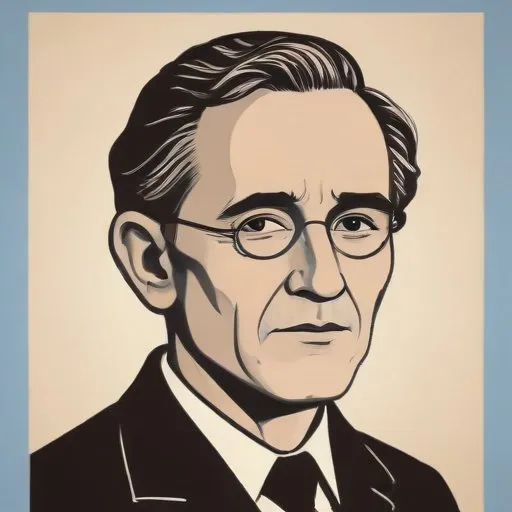
A Pulitzer Prize-winning poet and academic, known for his accessible and lyrical style, which explored themes of identity, morality, and the human condition.
Karl Shapiro, a renowned American poet, is best known for winning the prestigious Pulitzer Prize for Poetry in 1945 for his collection V-Letter and Other Poems. This esteemed recognition solidified his position as a leading literary figure of his time, and his work continues to inspire generations of poets and readers alike.
Shapiro was born on November 10, 1913, in Baltimore, Maryland, and spent his formative years in Chicago, Illinois, before returning to Baltimore. He attended Baltimore City College and briefly studied at the University of Virginia, where he wrote critically about the institution's racial and religious biases.
Shapiro's academic path led him to the Peabody Institute, where he majored in piano performance, and later to Johns Hopkins University, where he was awarded a scholarship from 1937 to 1939. His interests eventually shifted to library science, and he enrolled in a program associated with Baltimore's Enoch Pratt Free Library, where he also worked.
During World War II, Shapiro served as a United States Army company clerk in the Pacific Theater. It was during this period that he wrote some of his most acclaimed work, including V-Letter and Other Poems, which earned him the Pulitzer Prize. His wartime experiences deeply influenced his writing, and his poetry became a powerful reflection of his experiences and observations.
Throughout the war, Shapiro maintained a near-daily correspondence with his fiancée and future wife, Evalyn Katz. Katz played a vital role in Shapiro's literary career, serving as his literary agent and facilitating the publication of his early work.
In 1946, Shapiro became the fifth Poet Laureate Consultant in Poetry to the Library of Congress, succeeding Louise Bogan. This prestigious appointment cemented his position as a leading American poet and paved the way for a distinguished literary career.
Karl Shapiro's poetry and literary contributions have left an indelible mark on American literature. His work continues to be studied and admired for its nuance, depth, and powerful exploration of the human experience.
Through his writing, Shapiro illuminated the complexities of war, social justice, and personal relationships, leaving behind a rich literary legacy that continues to inspire and influence generations of writers and readers.
Born in 1917
A confessional poet who pioneered the personal, free-verse style, exploring themes of family, history, and mental illness in his work. He's known for his raw, introspective, and emotionally charged poetry.
93 Years Old
A confessional and emotionally intense writer who explored themes of mental illness, mortality, and femininity in her work, leaving a lasting impact on contemporary literature.
97 Years Old
A confessional poet who explored themes of mental illness, family, and femininity through her raw and intimate writing style, earning a Pulitzer Prize in 1967.
Born in 1914
A Pulitzer Prize-winning poet and scholar, known for his confessional and autobiographical poetry, exploring themes of identity, mortality, and the human condition.
Born in 1913
A poet and short story writer who explored the American Jewish experience and the human condition through his lyrical and introspective works. He's known for his unique blend of modernist and traditional styles.
Born in 1905
A Pulitzer Prize-winning novelist, poet, and literary critic, best known for his novel "All the King's Men", a classic of American literature.
Born in 1908
A Pulitzer Prize-winning poet, known for his introspective and emotionally charged works that explored the human condition, often using nature imagery to convey complex emotions.
Born in 1926
A leading figure of the Beat Generation, known for his poetry that explores themes of nonconformity, free expression, and social justice. His iconic poem "Howl" is a classic of American literature.
