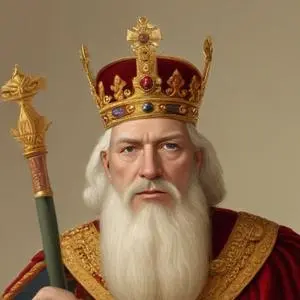
Leopold I, Holy Roman Emperor: A Life of Music, War, and Legacy
A Patron of the Arts and a Warrior King
Leopold I, Holy Roman Emperor, is remembered as a patron of music and a skilled composer, as well as a shrewd statesman who navigated the complex web of European politics during the late 17th century. Born on June 9, 1640, in Vienna, Leopold would go on to rule the Holy Roman Empire for 46 years, making him the second longest-ruling Habsburg emperor in history.
Early Life and Education
Leopold received a traditional education in the liberal arts, history, literature, natural science, and astronomy. His interest in music and the arts was evident from an early age, and he would go on to become a prolific composer, patronizing many prominent musicians and artists of his time.
Rise to Power
Leopold became heir apparent in 1654 after the death of his elder brother Ferdinand IV. He was elected Holy Roman Emperor in 1658, a position he would hold until his death in 1705. During his reign, Leopold faced numerous challenges, including conflicts with the Ottoman Empire and rivalry with
Louis XIV of France.
The Great Turkish War and the Treaty of Karlowitz
One of the most significant conflicts of Leopold's reign was the Great Turkish War (1683-1699), which pitted the Holy Roman Empire against the Ottoman Empire. After more than a decade of warfare, Leopold emerged victorious, thanks in large part to the military talents of
Prince Eugene of Savoy. The Treaty of Karlowitz, signed in 1699, marked a significant turning point in the war, as Leopold recovered almost all of the Kingdom of Hungary, which had fallen under Turkish power in the years following the 1526 Battle of Mohács.
Wars with France
Leopold also fought three wars against France: the Franco-Dutch War, the Nine Years War, and the War of the Spanish Succession. The War of the Spanish Succession, which began in 1701, was particularly contentious, as Leopold sought to give his younger son Charles the entire Spanish inheritance, disregarding the will of the late Charles II. The war would drag on until 1714, nine years after Leopold's death.
Legacy and Impact
Leopold's reign had a lasting impact on European politics and culture. He was a patron of the arts, and his court attracted many prominent musicians and artists. He also played a significant role in shaping the course of European history, navigating the complex web of alliances and rivalries that defined the late 17th century.
Personal Life and Milestones
Quotes and Memorable Sayings
"Music is the harmony of the universe, and the universe is the harmony of music."
Historical Context and Legacy
Leopold's reign was marked by significant conflict and upheaval, but he also played a crucial role in shaping the course of European history. He was a skilled statesman and a patron of the arts, and his legacy continues to be felt to this day.
Comparative Analysis with Contemporaries
Leopold's reign is often compared to that of his contemporary, Louis XIV of France. While both rulers were known for their military prowess and cultural achievements, Leopold's reign was marked by a greater degree of pragmatism and diplomacy.
Impact on Modern Society
Leopold's legacy can be seen in the many cultural and artistic achievements of the Holy Roman Empire during his reign. He played a significant role in promoting the arts and culture, and his court attracted many prominent musicians and artists.
Trivia and Fun Facts
- Leopold was known for his love of music and was a skilled composer.
- He was a patron of the famous composer Antonio Vivaldi.
- Leopold's court was known for its opulence and extravagance, and he was a prolific builder of palaces and churches.
Conclusion
Leopold I, Holy Roman Emperor, was a complex and multifaceted figure, known for his cultural achievements, military prowess, and diplomatic skill. His reign was marked by significant conflict and upheaval, but he also played a crucial role in shaping the course of European history.
FAQ
What was Leopold Is role in the Holy Roman Empire?
Leopold I was the Holy Roman Emperor from 1658 to 1705, serving as the head of state of the Holy Roman Empire and playing a crucial role in shaping European politics and history.
How did Leopold I respond to the Great Turkish War?
Leopold I played a key role in the Great Turkish War, leading the Holy Roman Empire to victory against the Ottoman Empire and securing the Treaty of Karlowitz in 1699.
What was Leopold Is relationship with the Habsburg family?
Leopold I was a member of the Habsburg dynasty, one of the most influential royal families in European history. He strengthened the familys position through strategic alliances and territorial expansion.
How did Leopold I support the arts and culture?
Leopold I was a patron of the arts, supporting artists, musicians, and writers. He encouraged the development of opera, and his court attracted prominent figures like Antonio Vivaldi and Johann Joseph Fux.
What was Leopold Is legacy in the Holy Roman Empire?
Leopold Is legacy is marked by his military victories, territorial expansion, and cultural achievements. He strengthened the Holy Roman Empire, solidified the Habsburg dynasty, and left a lasting impact on European history.