


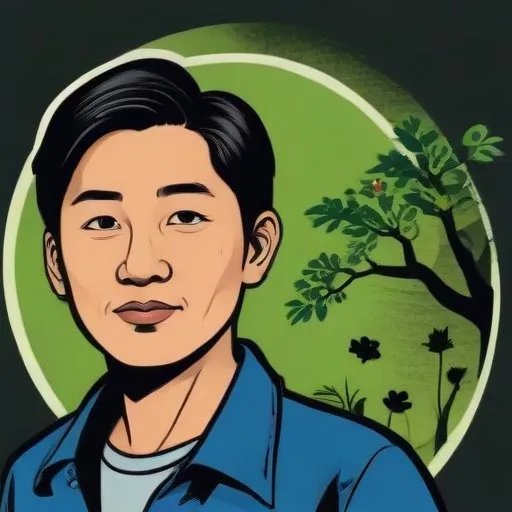
A pioneering Chinese environmentalist who founded the country's first environmental NGO, dedicated to promoting ecological awareness and conservation. He played a crucial role in shaping China's environmental movement.
Liang Congjie, a Chinese historian and environmental activist, is best known for establishing the Friends of Nature in 1994, the first environmental non-governmental organization (NGO) officially recognized by the Chinese government. This pioneering initiative marked a significant milestone in China's environmental movement, paving the way for a new era of eco-consciousness and sustainability.
Liang's dedication to environmental conservation was deeply rooted in his family's history. His father, Liang Sicheng, was a prominent architect who fought to preserve Beijing's ancient city walls, while his grandfather, Liang Qichao, advocated for a constitutional monarchy during the Qing Dynasty. Liang's ancestry, though, also brought challenges during the Cultural Revolution, when he was purged for his "royalist" connections.
Inspired by Greenpeace's activism, Liang and three colleagues from the Academy for Chinese Culture formed Friends of Nature to address China's growing environmental concerns. Unlike Greenpeace, Friends of Nature adopted a more collaborative approach, focusing on grassroots campaigns, environmental education, and community engagement. The organization's first birdwatching group and school programs raised awareness about the importance of conservation, paving the way for future environmental initiatives.
Liang worked closely with the Chinese government to enforce existing environmental laws, protecting endangered species like the Tibetan antelope and preserving old-growth forests in Western China. His efforts culminated in a 1999 ban on cutting down ancient trees, thanks to Friends of Nature's poignant video documentation of the destruction.
Environmentalist Ma Jun credited Liang with "incubating the first generation of environmentalists in China." Liang's constructive criticism and collaborative approach with the government helped build support for environmental protection, inspiring a new wave of eco-activists in China. Through Friends of Nature, Liang continued to champion environmental causes, leaving behind a lasting legacy that continues to shape China's environmental landscape.
"Environmental protection is not a slogan, it's a necessity. We must work together to ensure a sustainable future for China."
Liang Congjie's tireless efforts have inspired a new generation of environmentalists in China, fostering a culture of sustainability and eco-awareness. His work continues to influence environmental policy, ensuring a greener future for China and beyond. As a pioneer in China's environmental movement, Liang Congjie's legacy will be remembered for generations to come.
86 Years Old
A pioneering African woman who fought to protect the environment and promote democracy, earning her the Nobel Peace Prize for her groundbreaking efforts.
81 Years Old
A Brazilian rubber tapper who fought to preserve the Amazon rainforest and protect the rights of indigenous people, ultimately giving his life for the cause.
85 Years Old
A Nigerian writer and activist who led a nonviolent campaign against the exploitation of the Ogoni people and their environment, ultimately sacrificing his life for the cause.
Born in 1919
A pioneer in environmental science, he proposed the Gaia hypothesis, suggesting the Earth's physical and biological systems are interconnected and behave like a single living organism.
87 Years Old
A physician-turned-politician who championed environmental issues and sustainable development, leading the World Commission on Environment and Development. She's credited with popularizing the concept of sustainable development.
Born in 1901
A pioneering anthropologist and author who studied and wrote about diverse cultures, shedding light on human behavior and societal norms. Her groundbreaking work continues to influence modern anthropology and beyond.
Born in 1907
Pioneering biologist and environmentalist who exposed the dangers of pesticides and inspired the modern environmental movement through her groundbreaking book "Silent Spring".
Born in 1854
A German physician and biologist who discovered the first effective treatment for syphilis and developed the concept of chemotherapy, earning a Nobel Prize in Physiology or Medicine in 1908.
