


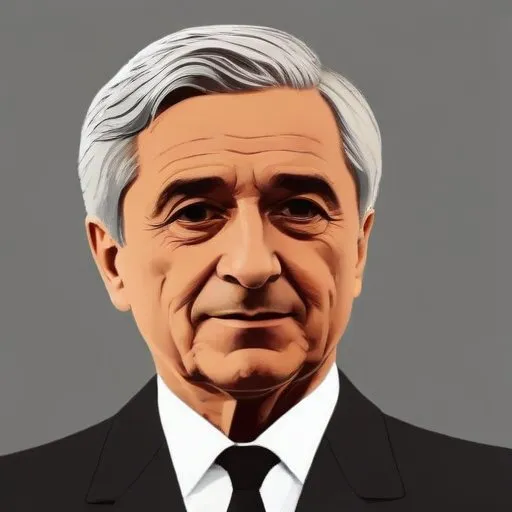
Italian financier and politician who led the Propaganda Due, a secret Masonic lodge involved in numerous scandals and conspiracies, including the collapse of a major bank and the murder of a journalist.
Licio Gelli is infamous for his role as the Venerable Master of the clandestine masonic lodge Propaganda Due (P2), a secretive organization that infiltrated the highest echelons of Italian politics, finance, and society. His involvement in the Banco Ambrosiano scandal, one of the most notorious financial crises of the 20th century, cemented his reputation as a master manipulator and criminal genius.
Gelli was born on April 21, 1919, in Pistoia, Tuscany, Italy. As a young man, he was drawn to fascist ideology and volunteered to fight in the Spanish Civil War alongside Generalissimo Franco's forces. He later served as a liaison officer between the Italian government and Nazi Germany, further solidifying his fascist credentials.
In the post-war era, Gelli established himself as a successful entrepreneur, founding his own textile and importing company. However, it was his involvement with Propaganda Due (P2) that catapulted him to notoriety. As the Venerable Master of P2, Gelli cultivated relationships with influential figures in Italy and abroad, including high-ranking politicians, business leaders, and members of the military.
In 1981, Gelli's world began to unravel when he was implicated in the Banco Ambrosiano scandal. The bank's chairman, Roberto Calvi, was found hanging from a bridge in London, and the subsequent investigation revealed a web of corruption and fraud that led directly to Gelli's doorstep.
Licio Gelli's life was marked by controversy and intrigue, leaving behind a trail of deceit and corruption that continues to fascinate and horrify to this day.
Licio Gelli's worldview was shaped by his fascist ideology, which emphasized nationalism, authoritarianism, and militarism.
Licio Gelli's impact on modern society extends beyond the realm of politics and finance, influencing popular culture and inspiring numerous artistic works.
Licio Gelli's net worth at the height of his power is estimated to have been in the hundreds of millions of dollars, amassed through a combination of illegal activities and legitimate business ventures.
Licio Gelli's life and exploits are inextricably linked to the tumultuous history of post-war Italy, marked by periods of social unrest, political instability, and economic turmoil.
90 Years Old
A billionaire media mogul who dominated Italian politics for decades, known for his flamboyant personality and numerous scandals.
92 Years Old
The 45th Prime Minister of Italy, a charismatic leader who dominated Italian politics in the 1980s, known for his flamboyant style and corruption scandals. He was a key figure in European politics during the Cold War era.
98 Years Old
An Italian academic and politician who served as the 8th President of Italy, known for his role in shaping the country's politics and foreign policy during the Cold War era. He was a key figure in Italy's transition from a monarchy to a republic.
Born in 1919
A dominant figure in Italian politics, serving as Prime Minister seven times, known for his cunning and controversial leadership style. He was a key player in shaping Italy's post-war politics.
Born in 1916
The 39th Prime Minister of Italy, a prominent figure in post-war Italian politics, known for his efforts to establish a historic compromise between Christian Democrats and Communists. He was kidnapped and murdered by the Red Brigades in 1978.
Born in 1922
Leader of the Italian Communist Party who implemented a policy of Eurocommunism, seeking to reform the party and distance it from Soviet influence.
Born in 1893
An Italian politician who played a crucial role in shaping the country's post-WWII government and was a key figure in the Italian Communist Party, known for his efforts to reform the justice system.
Born in 1908
Italian journalist and politician who served as Prime Minister of Italy six times, playing a key role in shaping the country's post-war politics and economy. He was a dominant figure in Italian politics for over three decades.
