


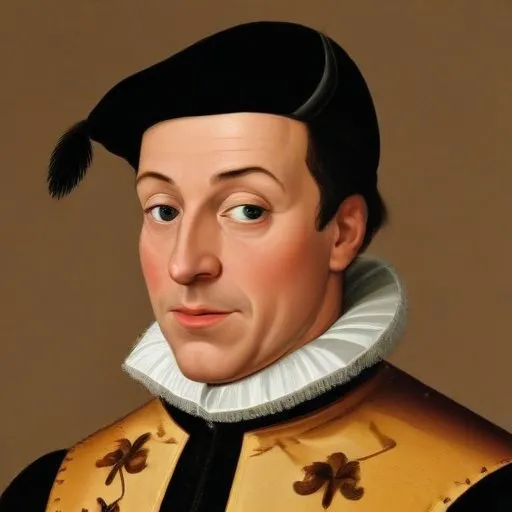
A French nobleman and military leader who played a key role in the French Wars of Religion, particularly the St. Bartholomew's Day Massacre.
Louis, Duke of Montpensier, is remembered as a rebellious nobleman who defied the conventional norms of the French monarchy. He is best known for his pivotal role in the Wars of Religion, a series of brutal conflicts that ravaged France during the 16th century.
Born on June 15, 1513, Louis was the youngest son of Charles, Duke of Orléans, and Louise of Savoy. His early life was marked by controversy, as his family's fortunes were intricately tied to the French throne. Louis's mother, Louise, played a significant role in shaping his character, instilling in him a strong sense of ambition and a willingness to challenge authority.
In 1560, Louis joined the Huguenot faction, a Protestant movement that sought to reform the Catholic Church. This decision led him to participate in several key battles, including the Battle of Dreux, where he was captured and imprisoned for several years.
Although Louis's military endeavors were marked by controversy and defeat, his actions had a profound impact on French history. His role in the Wars of Religion helped pave the way for the eventual Edict of Nantes, a decree that granted limited toleration to the Huguenots.
Louis's actions, although tumultuous, contributed to the eventual recognition of religious tolerance in France. His legacy serves as a reminder of the importance of challenging authority and fighting for one's beliefs, even in the face of overwhelming opposition.
The Wars of Religion, in which Louis played a significant role, were a defining feature of 16th-century France. The conflicts ultimately led to the recognition of Huguenot rights and paved the way for the Enlightenment thinkers who would later shape modern Europe.
Louis, Duke of Montpensier, was a complex figure whose life was marked by rebellion, controversy, and ultimately, tragedy. Yet, his actions had a profound impact on French history, shaping the course of religious tolerance and contributing to the country's rich cultural heritage.
Born in 1519
The Italian-French queen who married into the French monarchy and wielded significant power behind the scenes, known for her cunning politics and lavish court festivities. She sponsored the arts and architecture, leaving a lasting legacy on French culture.
Born in 1519
King of France from 1547 to 1559, known for his cultural and artistic patronage, and his role in the Italian Wars.
Born in 1519
King of France from 1547 to 1559, known for his cultural and artistic patronage, and his role in the Italian Wars.
Born in 1555
Younger brother of King Henry III of France, he was a French prince and a prominent figure in the French Wars of Religion, known for his intrigues and plots to gain power.
Born in 1553
The Queen of France who brokered peace between Catholics and Protestants through her marriage, but her lavish lifestyle and scandals sparked the St. Bartholomew's Day massacre.
Born in 1757
The last Bourbon king of France, ruling from 1824 to 1830, known for his ultra-royalist views and attempts to restore absolute monarchy, leading to the July Revolution.
Born in 1502
Introduced the Gregorian calendar, a solar-based calendar that's widely used today, reforming the Julian calendar's inaccuracies.
