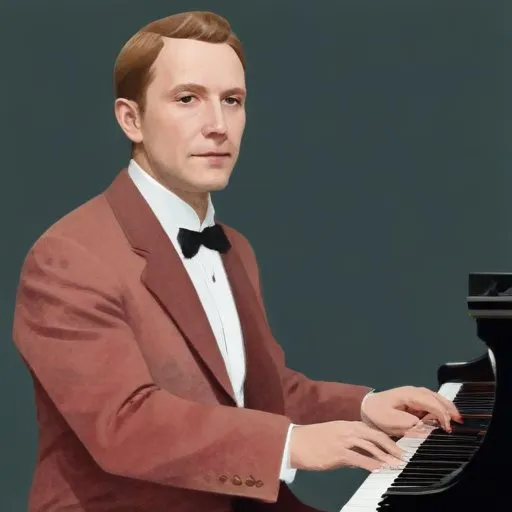
Ludvig Schytte: The Pioneering Danish Composer and Pianist
A Legacy of Musical Innovation
Ludvig Schytte, a Danish composer, pianist, and teacher, is renowned for his significant contributions to the world of music, particularly in the realm of piano composition. Born on 28 April 1848 in Aarhus, Denmark, Schytte's works continue to inspire and challenge pianists to this day, with his masterpieces remaining an integral part of the classical music repertoire.
Early Life and Training
Schytte's journey in music began with his training as a pharmacist, a career path he eventually abandoned in favor of pursuing his passion for music. He studied under the tutelage of Niels Gade and Edmund Neupert, before traveling to Germany in 1884 to further his skills under the guidance of the legendary composer and pianist, Franz Liszt.
A Life of Musical Endeavors
Schytte's prolific career spanned over three decades, during which he lived and taught in Vienna from 1886 to 1907, and later in Berlin until his death in 1909. His compositional output includes a diverse range of works, including a Piano Concerto in C-sharp minor, Opus 28, and a Sonata in B-flat major. Additionally, he penned two operas,
Hero and
Der Mameluk, which premiered in Copenhagen and Vienna, respectively.
Pedagogical Contributions
Schytte's commitment to pedagogy is evident in his numerous educational compositions, designed to instruct piano students of varying skill levels. His works, such as the
School of Modern Pianoforte Virtuosity, edited in collaboration with Moriz Rosenthal, and
The School of Modern Pianoforte Playing, provide valuable resources for students seeking to refine their technical and artistic abilities.
Lasting Impact
Schytte's legacy extends beyond his own compositions, as his teachings and influence have shaped the careers of numerous pianists and composers. His daughter, Anna Schytte, followed in his footsteps, becoming a talented composer and pianist in her own right. Today, Schytte's works remain an integral part of the classical music canon, with his piano pieces continuing to challenge and inspire pianists around the world.
Notable Works
- Piano Concerto in C-sharp minor, Opus 28
- Sonata in B-flat major
- Hero, opera (premiered in Copenhagen, 1898)
- Der Mameluk, opera (premiered in Vienna, 1903)
- School of Modern Pianoforte Virtuosity, edited with Moriz Rosenthal (ca. 1890)
- The School of Modern Pianoforte Playing, Op. 174 (1912)
A Legacy of Musical Excellence
Ludvig Schytte's life and works serve as a testament to his unwavering dedication to the art of music. As a composer, pianist, and teacher, he has left an indelible mark on the world of classical music, ensuring that his legacy continues to inspire future generations of musicians and music enthusiasts alike.
FAQ
What was Ludvig Schyttes contribution to Danish music?
Ludvig Schytte was a Danish pianist, composer, and educator who made significant contributions to Danish music, particularly in the genres of piano music and music education.
What was Ludvig Schyttes role in Danish music education?
Ludvig Schytte taught at the Royal Danish Academy of Music, where he trained many notable pianists and composers, shaping the course of Danish music education.
What are some of Ludvig Schyttes notable compositions?
Ludvig Schytte composed numerous piano pieces, including sonatas, waltzes, and nocturnes, as well as chamber music and choral works.
How did Ludvig Schytte influence Danish musical development?
Ludvig Schyttes teaching and compositional activities had a lasting impact on Danish musical development, shaping the countrys musical identity and influencing subsequent generations of musicians.
What was Ludvig Schyttes relationship with other notable composers?
Ludvig Schytte was acquainted with prominent composers of his time, including Carl Nielsen and Thomas Laub, and was part of a vibrant musical community in Denmark.