


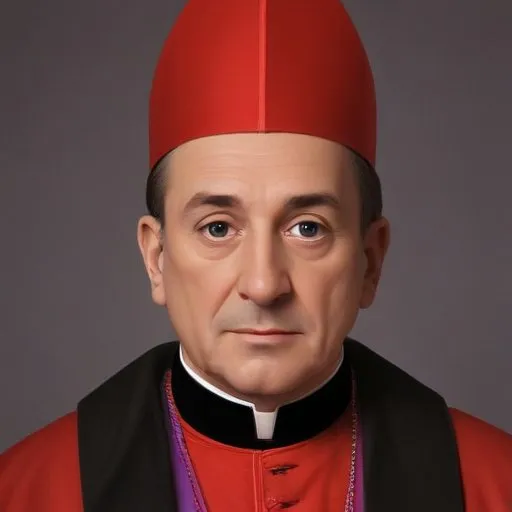
A 16th-century Catholic cardinal who served as a diplomat and advisor to European monarchs, known for his involvement in the Council of Trent and his efforts to reform the Catholic Church.
Luigi d'Este, an Italian Catholic cardinal, is best known for his influential role in the College of Cardinals and his patronage of the arts, particularly music. As the second son of Ercole II d'Este, Duke of Modena and Ferrara, and Rene, daughter of Louis XII of France, Luigi d'Este was born into a life of nobility and power.
Born on December 21, 1538, in Ferrara, Luigi d'Este was educated in the ways of the Church and politics from a young age. He was appointed Bishop of Ferrara in 1550 and later became Apostolic Administrator of Ferrara in 1561. In 1561, he was made a Cardinal of the Roman Catholic Church by Pope Pius IV, a position that granted him significant influence and power within the Church.
Luigi d'Este served as Cardinal Protector of the kingdom of France, a role that made him one of the most powerful and influential members of the College of Cardinals. He kept Arnaud d'Ossat, a skilled French diplomat, as his secretary, who would later become a cardinal himself. This position allowed Luigi d'Este to play a key role in the Papal conclave, 1585, and to exert significant influence over the Church's decisions.
Luigi d'Este was a patron of the arts, particularly music. He employed the renowned madrigal composer Luca Marenzio as his maestro di cappella from 1578 until his death. During this period, Marenzio published a significant portion of his works, including his Primo libro de madrigali a5, which was dedicated to Luigi d'Este. The cardinal's patronage of the arts helped to promote the development of music and culture in Italy during the Renaissance.
Luigi d'Este lived partly in Rome and partly at the Villa d'Este, Tivoli, which was built for his uncle Ippolito II d'Este. In Rome, he rented a large household from the Orsini family, near Piazza Navona, where he maintained a substantial famiglia or household. He also owned a villa suburbana on the Quirinal, which is now the residence of the President of Italy.
Luigi d'Este's legacy is that of a powerful and influential cardinal who played a significant role in the Church's decisions and promoted the development of the arts. His patronage of Luca Marenzio and other artists helped to promote cultural growth and development in Italy during the Renaissance. Despite his mounting debts, Luigi d'Este remains an important figure in the history of the Catholic Church and the Renaissance period.
Born in 1417
A 15th-century pope who played a significant role in the fall of the Western Schism, ending the division in the Catholic Church. He's also known for his lavish spending and nepotism.
Born in 1487
A 16th-century Pope who commissioned Michelangelo to paint the Sistine Chapel's frescoes and was a patron of the arts, leaving a lasting impact on Renaissance art and architecture.
Born in 1504
Leader of the Catholic Church during the Counter-Reformation, he excommunicated Queen Elizabeth I and played a key role in the Council of Trent.
Born in 1504
Leader of the Catholic Church during the Counter-Reformation, he excommunicated Queen Elizabeth I and played a key role in the Council of Trent.
Born in 1502
Introduced the Gregorian calendar, a solar-based calendar that's widely used today, reforming the Julian calendar's inaccuracies.
Born in 1414
Established the Vatican Archives and commissioned the Sistine Chapel's ceiling, which was famously painted by Michelangelo. He also played a significant role in the Renaissance.
Born in 1568
The 17th-century Catholic leader who reigned for 21 years, known for his strong stance against Galileo Galilei and his scientific discoveries, as well as his extensive patronage of the arts.
Born in 1554
Established the Congregation for the Propagation of the Faith, a missionary organization that aimed to spread Catholicism globally, and standardized the papal conclave process.
